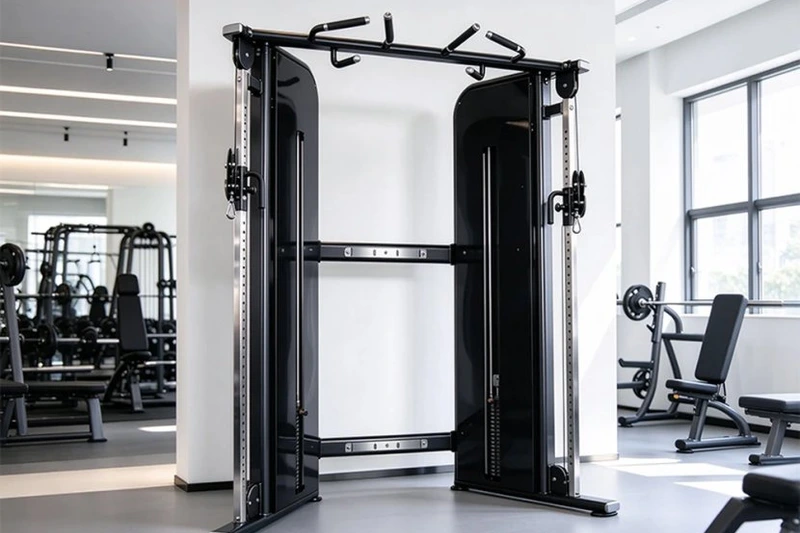
Cable-based strength training equipment is widely used in commercial gyms, fitness centers, sports clubs, and other training facilities. Among the available options, cable crossover machines and functional trainers are two common choices. Although both use adjustable pulleys and cable resistance, they differ in their structural design, training space, and primary applications.
Understanding these differences can help gym owners, fitness facility operators, and equipment buyers choose the right equipment for their training programs and available space. This article explains how the two machines compare and introduces the key features of a commercial cable crossover machine.
What Is a Cable Crossover Machine?
A cable crossover machine is a strength training device featuring two cable columns positioned on opposite sides of an open training area. Each column typically has its own weight stack and adjustable pulley, allowing users to perform exercises from different angles and heights.
The main purpose of this equipment is to provide controlled cable resistance for upper-body and other strength exercises. By changing the pulley height and exercise position, users can target different muscle groups, including the chest, shoulders, and arms.
A wide space between the two columns allows users to perform movements such as cable crossovers, chest flyes, and other cable-based exercises. Some models also include a pull-up bar, providing additional upper-body training options.
What Is a Functional Trainer?
A functional trainer is a versatile cable-based exercise machine designed to support different movement patterns and training activities. It commonly features two adjustable cable columns, allowing users to perform exercises from multiple directions.
Unlike equipment designed primarily for conventional strength exercises, functional trainers emphasize movement flexibility. Users can adjust cable positions and attachments to perform exercises involving pushing, pulling, rotating, and other movement patterns.
Depending on the model, a functional trainer may support exercises for the upper body, lower body, and core. Its design often focuses on providing multiple training options within a relatively compact structure.
Cable Crossover Machine vs. Functional Trainer: Key Differences
Although both machines use cable resistance and adjustable pulleys, their designs and training purposes are not exactly the same. The following comparison highlights their main differences.
| Comparison | Cable Crossover Machine | Functional Trainer |
| Structural Design | Usually features two independent weight-stack towers connected by a wide frame | Commonly uses a more compact dual-pulley structure |
| Pulley Arrangement | Allows the left and right pulleys to be adjusted independently at different heights | Offers adjustable pulley positions depending on the model |
| Main Purpose | Primarily focuses on cable resistance and strength training | Emphasizes different functional movement patterns |
| Training Space | Provides a relatively wide training area between the two columns | Generally has a smaller distance between the pulley columns |
| Exercise Types | Commonly used for cable resistance exercises and targeted muscle training | Supports multidirectional and combined movement exercises |
| Target Muscle Groups | Particularly suitable for chest, shoulder, and arm exercises | Supports exercises involving multiple muscle groups throughout the body |
1. Structural Design
One of the most noticeable differences is the overall structure.
A cable crossover machine generally features two separate weight-stack towers with a wide space between them. This arrangement provides room for users to move freely while performing cable exercises from different angles.
A functional trainer typically uses a more compact dual-pulley design. Its structure is intended to accommodate various exercise movements while making efficient use of floor space.
2. Pulley Adjustment
Both machines use adjustable pulleys, but their adjustment capabilities depend on the specific model.
On a cable crossover machine, the left and right pulleys can be positioned independently. This allows users to set different cable heights on each side for exercises such as cross-body movements.
Functional trainers also offer adjustable pulley positions, although the available adjustment range and locking positions vary between models.
3. Training Purposes
Cable crossover machines are commonly associated with resistance-based strength exercises. They allow users to perform controlled movements that target specific muscle groups, particularly the chest, shoulders, and arms.
Functional trainers focus more on movement variety. They can support different exercise directions and movement patterns, making them suitable for general fitness and functional training programs.
4. Space Requirements
The wider structure of a cable crossover machine provides a larger working area between its two pulley columns. This can be useful for facilities that prioritize cable-based strength exercises.
Functional trainers often have a more compact layout, making them an option for gyms with limited floor space.
However, buyers should consider the complete equipment dimensions and required exercise clearance rather than comparing the machines by their general categories alone.
5. Exercise Variety
Both machines support multiple exercises through adjustable pulleys and different cable attachments.
Cable crossover machines are particularly useful for exercises such as chest flyes, cable crossovers, and single-arm cable movements.
Functional trainers provide additional flexibility for exercises involving different movement directions and body positions. The available exercise options depend on the pulley configuration and compatible attachments.
How to Choose Between a Cable Crossover Machine and a Functional Trainer?
The right choice depends on the facility’s training objectives, available space, and equipment requirements.
Choose a cable crossover machine if:
- Your facility focuses on cable-based resistance and strength training.
- You need a wide working area between two pulley columns.
- Independent left- and right-side pulley adjustment is important.
- Your members frequently perform chest, shoulder, and arm exercises.
Choose a functional trainer if:
- Your training programs emphasize different movement patterns.
- You need equipment for multidirectional exercises.
- Floor space is limited and a more compact structure is preferred.
- Your facility offers general functional fitness training.
For commercial gyms, these two types of equipment can also serve different purposes within the same training area.
QF-G822 Cable Crossover Machine: Features and Applications
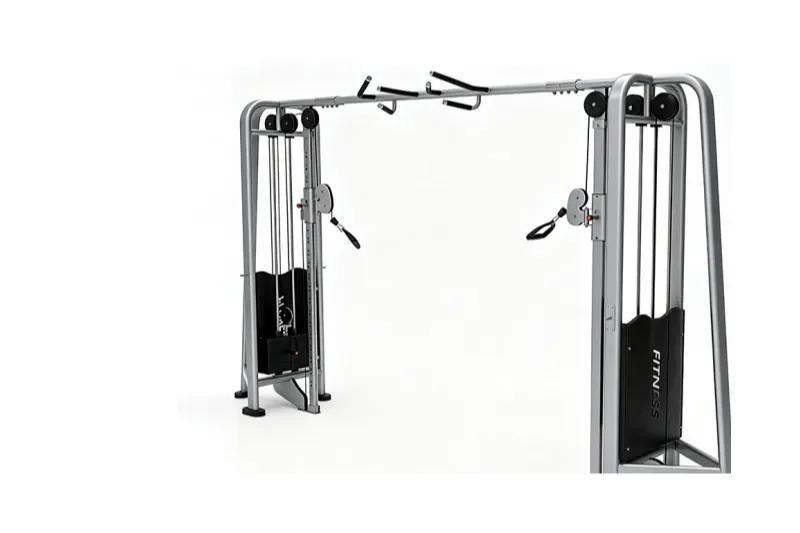
For commercial fitness facilities looking for a cable-based strength training station, the QF-G822 from Qifan is a cable crossover machine with two independent pulley towers and a wide training area.
Its design combines adjustable cable positions, separate weight stacks, and a multi-grip pull-up bar, providing several training options within one frame. For buyers looking for Custom commercial gym equipment, its available customization options also make it suitable for different commercial fitness projects.
1. Independent Dual Weight Stacks
The QF-G822 features two independent weight stacks, each with a capacity of 80 kg, providing 160 kg of combined weight-stack capacity.
Each side can be adjusted separately, allowing users to select different resistance levels for left- and right-side exercises. This arrangement supports both single-arm and bilateral training.
2. Multi-Position Pulley Adjustment
Both towers feature adjustable pulley carriages that lock at multiple heights along the inner columns.
Users can change the pulley positions according to their exercise requirements. The two sides can also be set at different heights, supporting cross-body movements and other cable exercises.
Single-handle straps are supplied as standard, while carabiner attachments allow users to add other compatible handles.
3. Multi-Grip Pull-Up Bar
In addition to the two adjustable cable stations, the QF-G822 includes a multi-grip pull-up bar across the top of the frame.
Its angled grips provide wide, neutral, and close hand positions, adding more upper-body exercise options to the equipment.
4. Heavy-Duty Steel Frame
The QF-G822 uses a steel frame with an overall net weight of 340 kg. Cross members connect the two towers at the middle and base, while leveling feet help stabilize the structure.
Its overall dimensions are 4340 × 740 × 2420 mm, providing a wide training area between the two towers.
5. Customization Options
For commercial gym projects with specific equipment requirements, the QF-G822 supports customization of frame colors, seat colors, and logos.
These options allow gym operators and equipment buyers to coordinate the equipment’s appearance with their facility branding and project requirements.
Applications of the QF-G822
The QF-G822 is designed for commercial fitness environments and can be used in several types of facilities.
- Commercial Gyms: Suitable for gyms and fitness chains that need cable-based strength training equipment for members with different fitness levels and training goals.
- Hotel and Apartment Gyms: Its combination of two cable stations and a pull-up bar provides multiple exercise options within one equipment frame.
- Sports Training Facilities: Supports functional exercises, strength development, and supplementary training for athletes.
- Schools and Sports Clubs: Can be incorporated into school fitness facilities and club training areas to provide additional strength training options.
When sourcing equipment for commercial fitness projects, working with an experienced commercial gym equipment Manufacturer can help buyers evaluate product configurations, customization requirements, and equipment suitability for their facilities.
Technical Specifications of the QF-G822
| Item | Specification |
| Model | QF-G822 |
| Product Type | Cable Crossover Machine |
| Application | Commercial Gym and Fitness Facility |
| Overall Size | 4340 × 740 × 2420 mm |
| Net Weight | 340 kg |
| Gross Weight | 380 kg |
| Weight Stack | 80 kg × 2 |
| Frame Material | Steel |
| Frame Color | Customized |
| Seat Color | Customized |
| Logo | Customized Logo Available |
| Certification | CE, ISO9001 |
| Packing | Wooden Box |
| Brand | QF |
| Place of Origin | Hebei, China |
Conclusion
Cable crossover machines and functional trainers both provide cable-based resistance training, but their structural designs and training priorities differ. Cable crossover machines generally offer a wider training area and focus on controlled strength exercises, while functional trainers emphasize movement variety and multidirectional training.
For commercial gyms and fitness facilities that prioritize cable-based strength training, the QF-G822 offers two independent 80 kg weight stacks, adjustable pulleys, and a multi-grip pull-up bar. With customization options for frame colors and logos, it can also accommodate different commercial gym equipment project requirements.
If you are looking for a reliable cable crossover Manufacturer or cable crossover Supplier, Qifan provides equipment options for commercial fitness facilities. Contact our team to discuss your equipment requirements, customization options, and project needs.
FAQs
1. Can a cable crossover machine be used for full-body training?
Yes. By adjusting the pulley heights and using different cable attachments, users can perform exercises targeting the chest, shoulders, arms, and other muscle groups.
2. What is the difference between a cable crossover machine and a functional trainer?
A cable crossover machine generally provides a wider training area and focuses on cable-based strength exercises, while a functional trainer emphasizes different movement patterns and multidirectional training.
3. What customization options are available for the QF-G822?
The QF-G822 supports customization of frame colors, seat colors, and logos to meet different commercial gym project requirements.