Padel is one of the fastest-growing racket sports in the world, and commercial property owners are taking notice. But for many investors, the barrier has never been the demand for the sport. It has been the site itself. A traditional padel court usually needs a concrete foundation, permanent anchoring, and a location that can be locked in for years. That rules out a lot of promising commercial space before the project even starts.
A portable padel court changes that calculation. It eliminates the need for a traditional concrete foundation and features a modular, movable structure, allowing previously unused commercial spaces to be used for padel courts. At QIFAN, we manufacture the PD05 portable padel court specifically to serve this market, and this article explains where it can be used in real commercial projects and why the design makes it a practical choice for business planning.
What Makes a Portable Padel Court Different
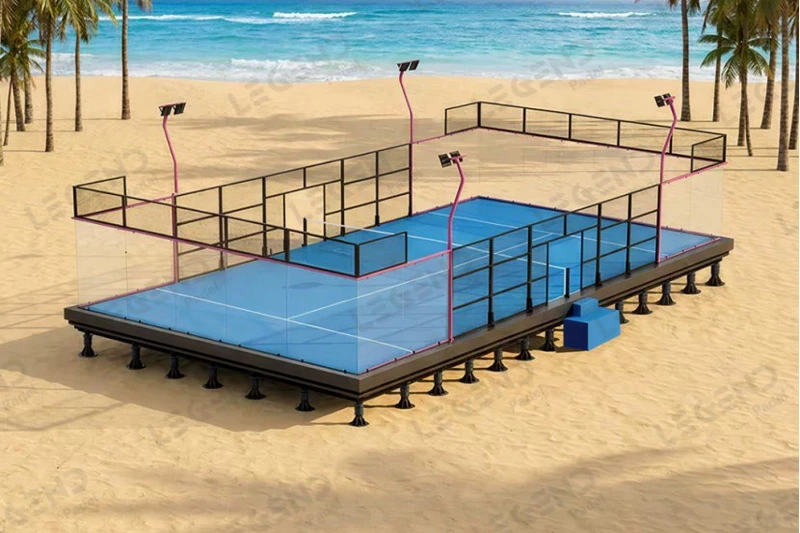
To understand how padel court design affects installation flexibility, it helps to look at how a mobile padel court is built. QIFAN’s PD05 portable padel court uses an independent perimeter steel plate support system. The court body connects directly to the outer steel plates, forming one integrated load-bearing structure. That design removes the need for the conventional concrete foundation work that a fixed court normally requires.
Because the structure does not depend on a poured concrete base, it can be installed on a flat, smooth surface that meets basic requirements for levelness, load-bearing capacity, and stability. This does not mean any floor will work, but it does mean the options are far wider than a fixed padel court allows. The court is also modular, so it can be dismantled, transported, and reassembled on another site. For a commercial operator, that flexibility feeds directly into a padel court business plan, because the same asset can move between projects instead of being tied to one location.
Where Portable Padel Courts Fit in Commercial Projects
Rooftop Padel Courts
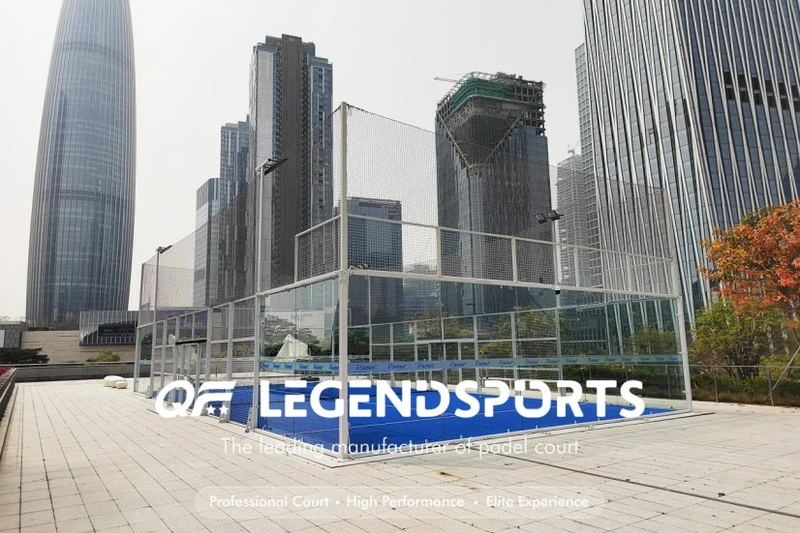
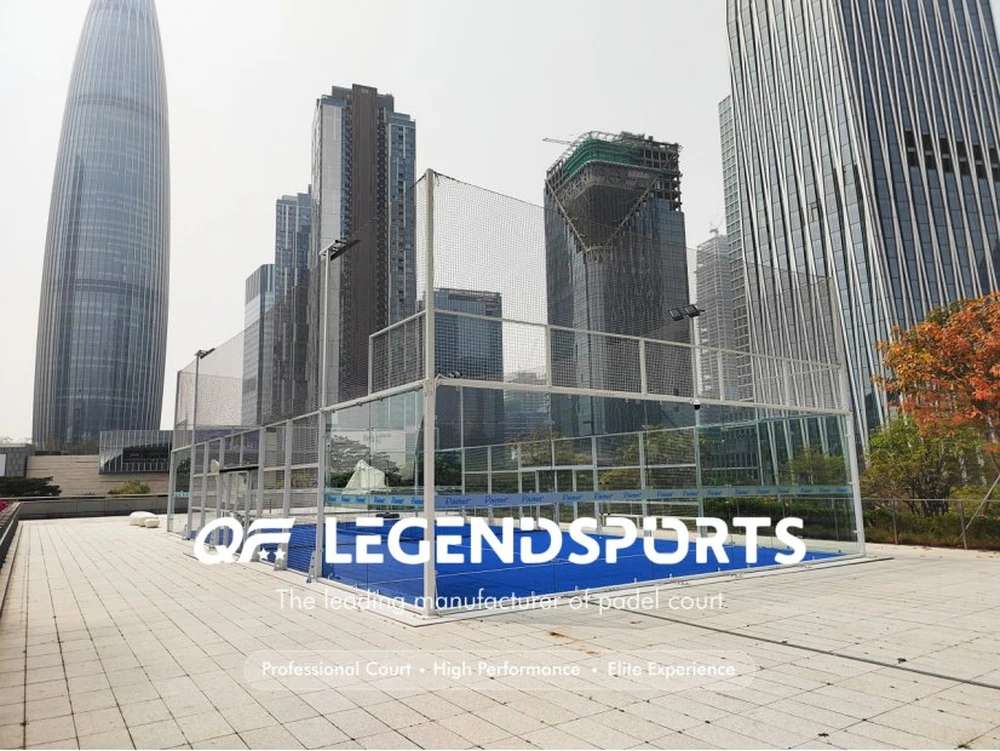
Commercial building rooftops, hotel roofs, and shopping mall roofs are some of the most underused square meters in any city. A rooftop padel court turns that dead space into a sports and leisure amenity. For an urban commercial complex, adding a court on the roof creates a new entertainment offering without taking up ground-floor retail space.
Rooftop installations do need advance planning. The building’s load-bearing capacity, waterproofing, drainage, and wind load all have to be evaluated before installation. These are engineering checks, not design limitations, and once they are confirmed, the lightweight, steel-supported structure makes a rooftop court a realistic option.
Shopping Malls
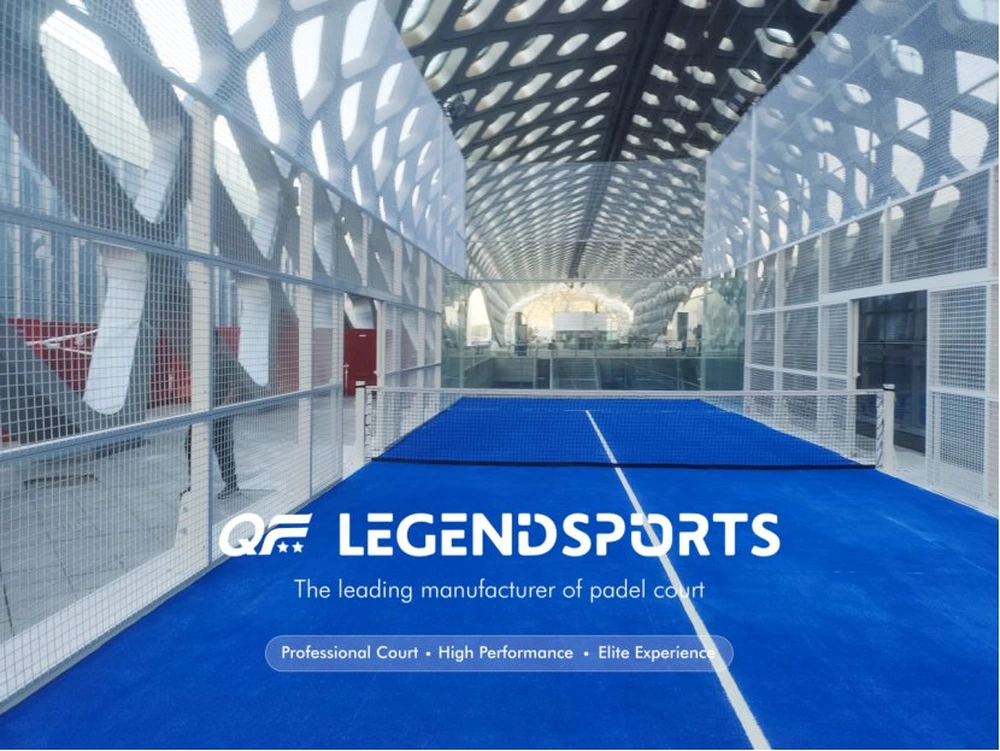
Shopping malls are constantly looking for reasons to bring people through the door. A padel court in a mall atrium, indoor activity space, or a suitable outdoor area converts idle commercial space into a sports experience zone. It adds an entertainment option that gives consumers a reason to visit, and it works for both long-term operation and short-term promotional campaigns.
Because the court is modular, a mall can test the concept in one season, relocate it to a different floor or atrium the next, and only commit to a permanent build when the results justify it.
Exhibitions and Trade Shows
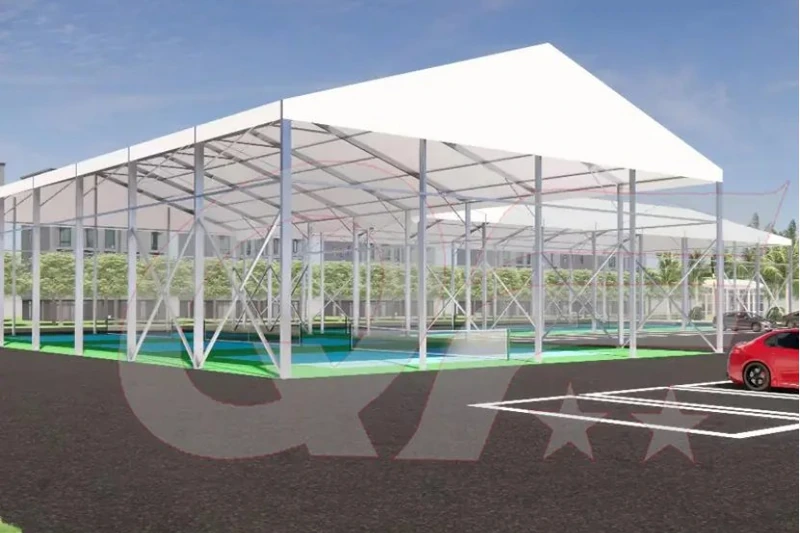
At sports equipment shows, international trade fairs, and commercial exhibitions, suppliers need to show a real product, not just a brochure. A portable padel court can be assembled on the show floor as a live display and experience area. Visitors can see the structure, inspect the materials, and understand the product details in a way a photo never communicates.
After the event, the court is dismantled, transported, and reused at the next exhibition. The same asset serves multiple shows, which is a practical advantage for manufacturers and distributors who exhibit regularly.
Temporary Events and Sporting Activities
Temporary padel tournaments, sports festivals, brand promotion events, and commercial celebrations all share one problem: the venue is only needed for days or weeks. Building a permanent court for a short event makes no financial sense. A mobile padel court solves that. It can be set up for the event and taken down when it ends, then moved to the next location.
This makes the court a working asset for event organizers, marketing agencies, and sports promoters rather than a one-time construction cost.
Hotels and Resorts
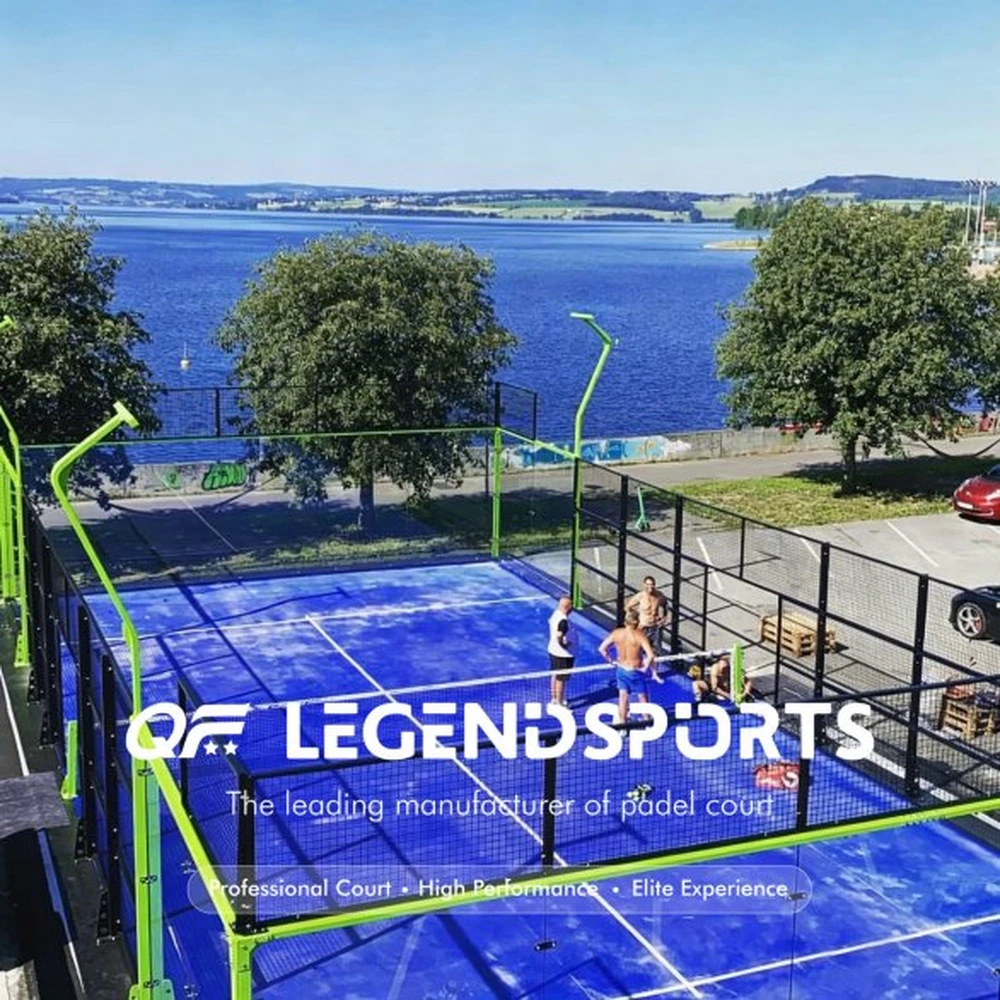
Hotels and resorts compete on experience. A padel court on a hotel rooftop, in an indoor sports space, or on an outdoor leisure area adds a recreational facility that many competitors do not offer. For a resort, the court becomes part of the property’s sports amenities, giving guests another reason to stay and creating a new leisure scenario that can be marketed to groups and families.
For a hotel operator, the portable design is especially valuable because the court can be moved between areas or removed entirely if the property is reconfigured.
Commercial Padel Clubs and Sports Centers
Indoor padel clubs, commercial sports centers, and multi-sport venues are the most obvious home for a padel court, but even here the portable design offers advantages. A warehouse or factory space can be converted into an indoor club without pouring a concrete foundation. A venue can plan one court first and add more as demand grows, because the modular structure scales with the floor plan.
For a club operator, the ability to relocate the court also protects the investment if a lease ends or the business needs to move to a larger location.
PD05 vs. a Traditional Fixed Court
The difference between a portable padel court and a conventional fixed court comes down to how each one is built and what that means for a project. The table below summarizes the key points.
| Comparison Item | PD05 Portable Padel Court | Traditional Padel Court |
| Foundation structure | Independent perimeter steel plate support system | Typically a fixed foundation |
| Concrete foundation | No traditional concrete foundation required | Usually required |
| Installation surface | Flat, smooth surface meeting load requirements | Determined by foundation design |
| Installation method | Modular connection | Fixed installation |
| Dismantling | Can be dismantled and reassembled | Usually difficult to dismantle |
| Application scenarios | Rooftops, malls, exhibitions, clubs, and more | Conventional fixed commercial venues |
The core difference is that a traditional padel court is a construction project, while the PD05 is closer to a deployable asset. That distinction is what opens up rooftops, malls, and exhibitions as realistic commercial sites.
Why Commercial Buyers Choose the PD05
From the perspective of a B2B buyer or commercial investor, the decision usually comes down to a few practical concerns.
Flexible site selection. The portable design expands the range of locations a project can consider, which means more opportunities to find affordable or high-traffic space.
Reduced foundation work. Skipping the conventional concrete base cuts down on early-stage construction, which can shorten the timeline and reduce upfront cost.
Space utilization. Rooftops, malls, and other special commercial spaces become usable, turning previously idle areas into revenue-generating facilities.
Easy relocation. The court can be dismantled, transported, and reinstalled, which protects the investment and opens up future site options.
Temporary and permanent applications. The same court works for a short-term event or a long-term commercial operation, giving buyers more than one business model to pursue.
Commercial project flexibility. Different sites and different business models require different setups, and the modular padel court adapts to that range instead of forcing a one-size-fits-all build.
Product Parameters
The table below lists the key specifications of QIFAN’s PD05 portable padel court.
| Item | Specification |
| Product model | PD05 |
| Court size | 20 meters long x 10 meters wide |
| Surface course | Artificial short grass, 12mm, compliant with GB/T 20394-2013 “Artificial Grass for Sports”; sand filling with 120-mesh quartz sand at 5kg per square meter, evenly distributed |
| Tempered glass | Explosion-proof tempered glass, 2995mm x 1995mm x 12mm |
| Column and fence | High-quality steel pipe; corner column 100mm x 100mm x 3mm; crossbeam 50mm x 100mm x 3mm; other columns 50mm x 100mm x 3mm; 10mm-thick movable steel plates around the bottom, assembled/disassembled as needed |
| Mesh | 4mm diameter, 50mm x 50mm opening |
| Lighting | 8 x 200W LED fixtures, lamp posts embedded inside the fence at 6000mm height, 300 lux illumination |
| Span | 20–30m, customizable |
| Wind load | Up to 120km/h |
| Membrane material | PVDF / PTFE |
| Frame material | HDG steel / aluminum |
| Customization | Fully supported |
Conclusion
A portable padel court is not just a different version of a fixed court. It is a different way of thinking about where padel can be played and how a commercial project can be built. By removing the concrete foundation, making the structure modular, and allowing relocation, the PD05 opens up rooftops, malls, exhibitions, hotels, and clubs as realistic sites for padel. For a commercial buyer, that flexibility is the difference between a project that has to find the perfect fixed location and a project that can bring the court to wherever the opportunity is.
If you are planning a commercial padel project and want to know whether your site can support a portable court, contact QIFAN. We can review your location, confirm the surface and load requirements, and help you build a padel court business plan around the PD05.
Frequently Asked Questions
Does a portable padel court need a concrete foundation?
No. QIFAN’s PD05 uses an independent perimeter steel plate support system, so it does not require the traditional concrete foundation that a fixed padel court normally needs. The court can be installed on a flat, smooth surface that meets basic requirements for levelness, load-bearing capacity, and stability.
Can the court be moved to another location after installation?
Yes. The PD05 is a modular structure that can be dismantled, transported, and reassembled on a new site. This makes it suitable for temporary events and exhibitions as well as long-term commercial operations, and it lets owners relocate the court if a project or lease changes.
Where can a portable padel court be installed?
The court works on rooftops, in shopping malls, at exhibitions and trade shows, at temporary events, in hotels and resorts, and in commercial padel clubs or sports centers. Before installation, factors such as floor levelness, load-bearing capacity, drainage, and wind load should be evaluated for the specific site.