Introduction
Padel is one of the fastest-growing sports in the world. As clubs, hotels, and commercial developers race to add courts to their facilities, one question keeps coming up early in every project: what goes underneath the court?
A padel court is a precisely engineered structure — glass panels, steel posts, mesh fencing, and an artificial turf surface all have to fit together within tight tolerances. None of that works well if the ground beneath it is uneven, soft, or sloped.
Traditionally, the answer has been a poured concrete slab. Concrete works, but it is not always the best or most practical choice. For many sites, a modular foundation system offers a faster, cleaner, and more flexible way to prepare the ground for padel court installation.
This article explains what a padel court foundation actually does, why traditional concrete can be limiting, and the specific benefits a modular approach brings to building a padel court on challenging ground.
The Limits of Traditional Concrete Foundations
A poured concrete slab has been the standard for padel courts for a long time. Concrete is strong, durable, and familiar to almost every contractor.
But concrete has real drawbacks, especially when the site is not naturally flat.
First, concrete requires extensive ground preparation. Before the slab can be poured, the site usually has to be leveled and compacted. On sloped or uneven ground, this can mean importing fill material, cutting into the existing grade, or both. That is time and cost spent before the court itself is even started.
Second, concrete is permanent. Once it is poured, it is extremely difficult to move or adjust. If a facility later wants to reconfigure its courts or relocate a court to a different part of the property, the old slab is a liability rather than an asset.
Third, concrete is weather-dependent and slow. Pouring, curing, and finishing a slab can take days, and the schedule can be disrupted by rain or cold. For a commercial developer trying to open on time, those delays have a direct financial impact.
What Is a Modular Foundation System?
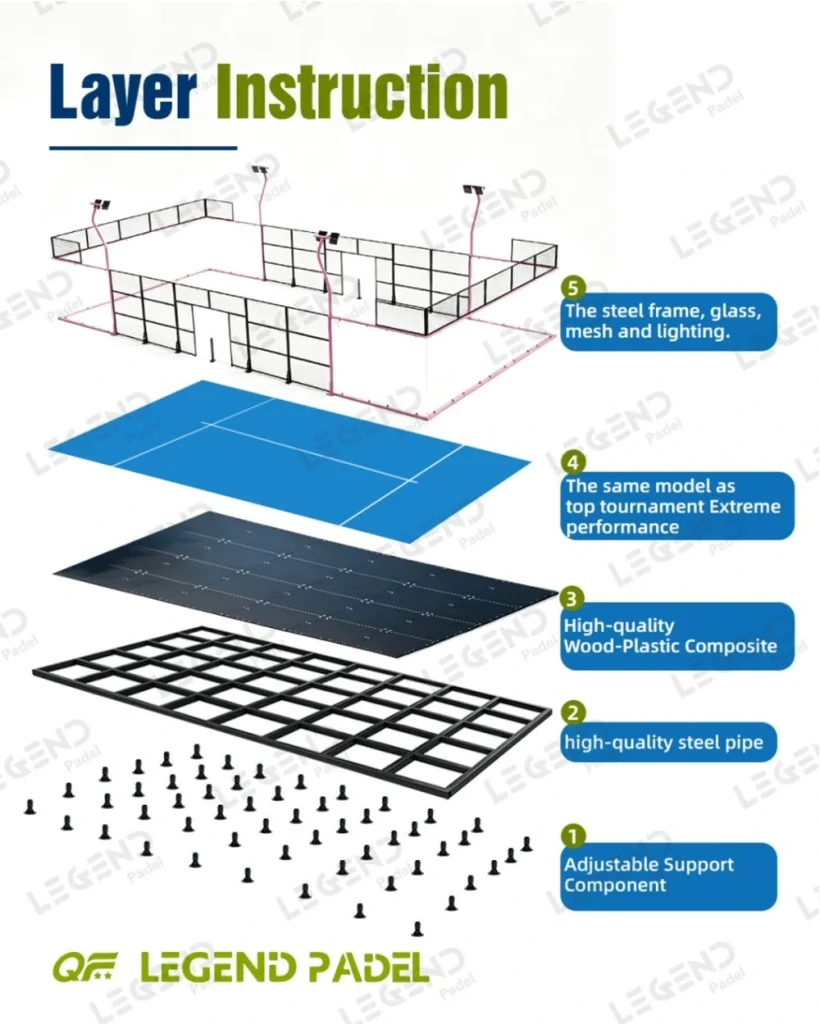
A modular foundation system takes a different approach to the same problem. Instead of pouring a single continuous slab, the system uses a set of prefabricated steel frames that are assembled on site and supported by adjustable feet. A solid surface board is laid across the top of the frames to create the level platform the court needs.
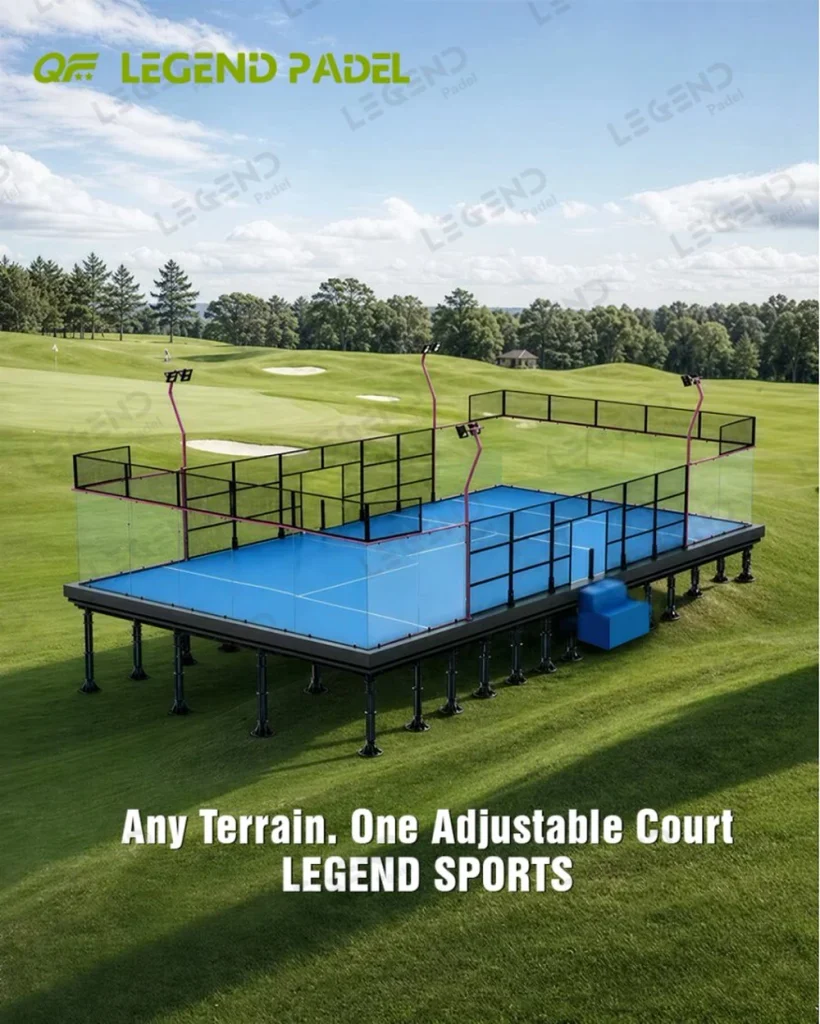
The key idea is adjustability. Because the support feet can be raised or lowered independently, the system can compensate for differences in ground level without requiring the ground itself to be flattened first. This is what makes a modular system particularly valuable on grass, sand, uneven ground, and other challenging surfaces. The result is a stable, level base for padel court installation without extensive groundworks.
Key Benefits of a Modular Foundation for Padel Courts
The advantages of a modular foundation system fall into a few clear categories. Each one maps directly to the realities of real-world padel court construction.
1. Faster Installation
Speed is one of the most immediate benefits. A modular system is assembled from prefabricated frames rather than poured on site, which removes the curing time that concrete demands. There is no waiting for the slab to set and reach strength — the foundation can be built up frame by frame as soon as the components are on site.
For a business that wants to start generating revenue from a new court, this shorter timeline matters. It means less downtime for the site, faster commissioning, and a quicker return on the investment.
2. Easier Site Preparation
Concrete demands a level, compacted base before a single pour. A modular foundation, by contrast, is designed to work with the ground rather than against it. The adjustable support feet allow the installer to level the platform from above, compensating for the natural variations in the ground below.
This dramatically reduces the amount of groundworks required. Instead of cutting, filling, and compacting a site into submission, the team can often set the foundation directly onto the existing surface and adjust each support point to the correct height.
3. Greater Flexibility
Flexibility is a benefit that extends well beyond installation day. Because a modular foundation is assembled from separate components, it can be disassembled and reconfigured far more easily than a concrete slab.
This matters for several kinds of projects. A sports club that wants to test demand for padel before committing to a permanent build can install courts on a modular base and relocate them later if needed. A developer working on leased land can install courts without leaving a permanent concrete structure behind. And any facility that might need to change its court layout in the future keeps its options open.
4. Adaptability to Challenging Ground
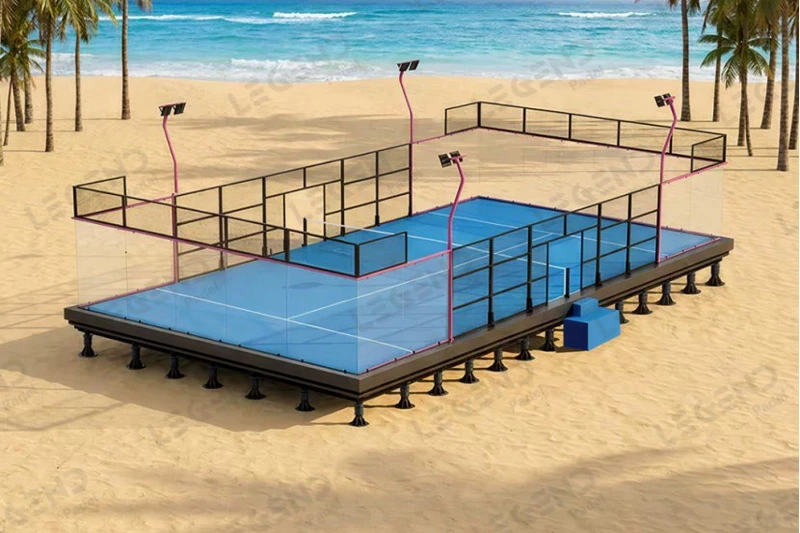
Perhaps the most distinctive advantage is the ability to handle ground that would make a concrete slab impractical or very expensive. Grass, sand, and uneven terrain are all well within the capability of a well-designed modular system, thanks to the adjustable support feet.
This adaptability means padel can be installed in locations that were previously considered unsuitable — hillside resorts, coastal properties on sandy soil, or existing outdoor spaces with noticeable elevation differences. The foundation adapts to the site, rather than the site having to be reshaped to suit the foundation.
5. Cleaner, More Reversible Build
Finally, a modular foundation leaves a much lighter footprint on the land. There is no permanent concrete mass to break up and haul away if the court is ever removed.
Where Modular Foundations Are Most Useful
The modular approach shines in specific project conditions. Understanding these helps buyers see whether the system fits their own situation.
Hotels and resorts often build courts on varied terrain, including landscaped grounds, rooftops, or areas where heavy excavation is undesirable. A modular foundation lets them add padel with minimal disruption to the surrounding property.
Sports clubs value the speed and the flexibility to reconfigure their facilities as demand changes. A modular base supports that without locking the club into a permanent layout.
Commercial developments frequently face tight schedules and site conditions that favor a quick, low-impact foundation. Uneven outdoor sites and sloped areas are the natural home for an adjustable system, while existing spaces with elevation differences can be brought to level without costly groundworks.
Product Overview: An Adjustable Modular Foundation System
For projects that need a dependable solution to these challenges, a purpose-built adjustable modular foundation offers a complete answer — and it is exactly what the QIFAN Modular Padel Court Foundation System is engineered to deliver.
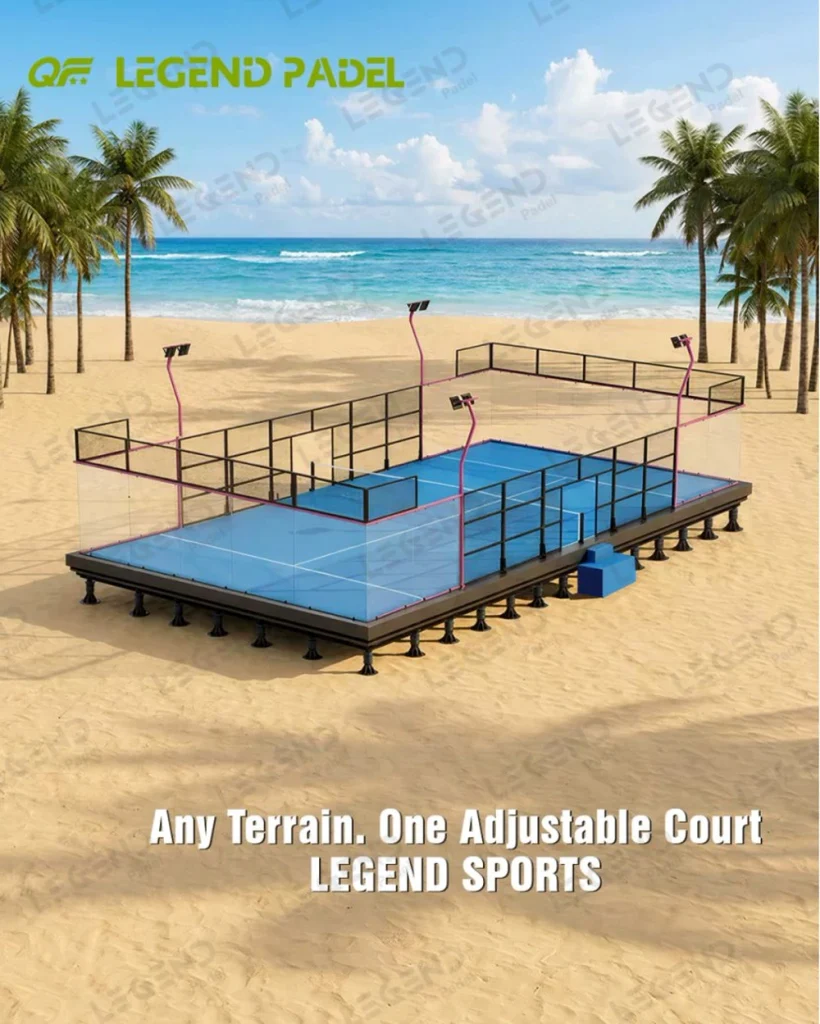
The QIFAN modular foundation system provides a flexible alternative to traditional concrete foundations. It is designed for grass, sand, uneven ground, and other challenging surfaces, creating a stable and level base for padel court installation without extensive groundworks.
The support feet offer an adjustment range of 150–800 mm, giving the installer the ability to level the foundation according to the actual conditions of the site. Each foot is adjusted individually, which is what allows the system to compensate for ground level differences and work on sloped or uneven ground.
The foundation itself is a modular steel structure built from high-quality steel tube, delivered as 30 modular frames for on-site assembly with 304 stainless steel fasteners. This modular design makes the components easy to transport and flexible to install.
The table below summarizes the key specifications of the QIFAN modular foundation system at a glance.
| Item | Specification |
| Product Type | Adjustable Modular Padel Court Foundation |
| Main Application | Uneven Ground |
| Adjustable Support Feet | 150–800 mm |
| Outer Frame | 50 × 150 × 3.0 mm High-Quality Steel Tube |
| Internal Beams | 40 × 80 × 3.0 mm High-Quality Steel Tube |
| Purlins | 30 × 50 × 2.0 mm High-Quality Steel Tube |
| Modular Frames | 30 Frames |
| Fasteners | 304 Stainless Steel |
| Foundation Surface | High-Quality Solid Plastic Board |
| Board Size | 140 × 20 mm |
| Standard Configuration | QF-BQ04 Padel Court |
| Customization | Other Padel Court Models Available |
Across the top of the steel frame sits the high-quality solid plastic board, sized at 140 × 20 mm, which forms the foundation surface that the padel court and artificial turf are installed onto.
The system is engineered for demanding conditions, with a clear span of 20–30 meters (customizable) and the ability to withstand wind loads of up to 120 km/h.
The standard configuration is the QF-BQ04 Padel Court, with customization available for other padel court models. Customization can be made according to court dimensions, structural requirements, and the specific conditions of the project.
Conclusion
A stable foundation is essential to the long-term performance of any padel court. For uneven, sloped, or challenging ground, a modular foundation system offers a practical alternative to traditional concrete, with faster installation, less ground preparation, and greater flexibility.
Whether you are building a padel court for a hotel, sports club, or commercial project, QIFAN’s modular foundation system provides an adjustable solution tailored to different site conditions. Contact QIFAN today to learn more about the QIFAN Modular Padel Court Foundation System and discuss a suitable foundation solution for your project.
Frequently Asked Questions
1. What types of ground are suitable for a modular padel court foundation?
A modular padel court foundation is suitable for grass, sand, uneven ground, and sloped areas. Its adjustable support feet help create a level platform without extensive ground preparation.
2. How does a modular foundation differ from a concrete foundation?
A modular foundation uses prefabricated steel frames and adjustable support feet, allowing faster installation, easier site preparation, and greater flexibility for future relocation compared with traditional concrete foundations.
3. What is the adjustment range of the QIFAN modular foundation system?
The QIFAN Modular Padel Court Foundation System features adjustable support feet with a height range of 150–800 mm, allowing the foundation to accommodate different ground levels and site conditions.