Introduction
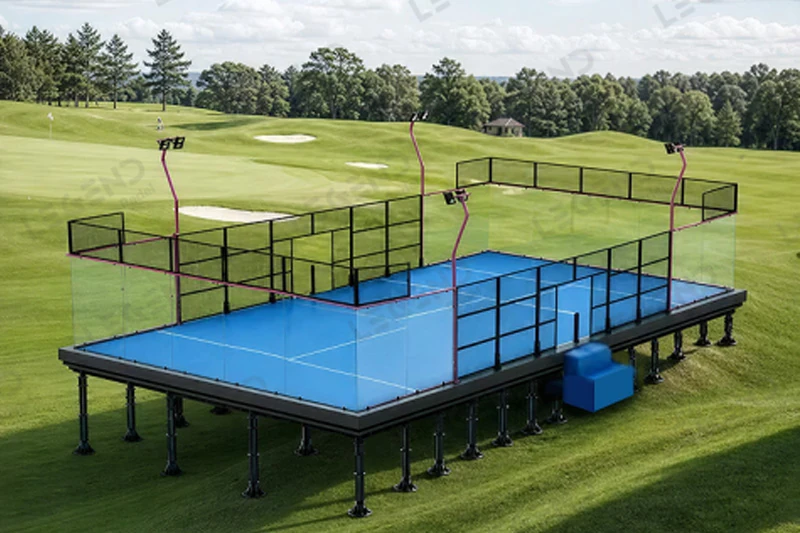
Buying an outdoor padel court involves more than comparing designs or selecting the lowest factory price. For a commercial project, the court must function as a complete installation, covering everything from the foundation and drainage to the steel structure, glass, turf, lighting, shipping, and on-site assembly.
Before contacting padel court manufacturers, buyers should define the installation environment, expected usage, technical requirements, and total project budget. This guide provides a practical framework for comparing padel courts for sale, evaluating padel court equipment, and assessing manufacturer capabilities. It also uses the Qifan PD06 as an example to show how technical specifications can inform purchasing decisions.
Key Takeaways
- Evaluate an outdoor padel court according to site conditions, climate, structural design, equipment, and total project cost.
- Check the steel structure, corrosion protection, tempered glass, artificial turf, lighting, foundation, and drainage before purchasing.
- Outdoor projects in coastal, humid, windy, or cold environments require particular attention to corrosion protection, wind-load design, drainage, and material durability.
- Grass, sand, rooftops, and uneven sites may require an alternative foundation solution rather than a conventional concrete base.
- Compare the complete project cost instead of relying on the factory court price alone.
- Verify applicable standards, certifications, structural documentation, and wind-load calculations before placing an order.
- Use actual product specifications to compare manufacturers and identify whether a proposed court matches the requirements of your project.
Define Your Outdoor Padel Court Project Requirements
Assess the Installation Site
The first step is to assess the site before requesting quotations. A manufacturer cannot properly recommend a foundation, drainage solution, or installation method without understanding the basic site conditions.
Because an outdoor padel court may be installed on diverse and challenging surfaces—such as concrete, grass, sand, or rooftops—different environments require tailored foundational approaches. Consequently, comprehensive site data should be included directly in the initial RFQ.
Match the Court to Your Application
The intended use also affects the specification.Specification for commercial padel clubs typically require equipment designed for frequent daily use, while hotels, resorts, private developments, and residential projects may place greater emphasis on appearance, customization, or integration with the surrounding property.
For distributors and sports facility procurement teams, additional factors may include packaging, customization, technical documentation, installation support, and repeat-order consistency.
The expected usage intensity can influence requirements for structural durability, equipment configuration, foundation design, and future maintenance.
Evaluate Outdoor Weather Resistance, Structure, and Core Equipment
Outdoor courts remain exposed to changing weather throughout their service life. Rain, humidity, wind, temperature changes, coastal salt, and snow can all affect material performance and maintenance requirements.
Outdoor Weather Resistance and Environmental Adaptability
For exposed outdoor installations, buyers should proactively consult manufacturers on how their proposed courts handle critical performance factors, including:
- Corrosion protection
- Wind-load design
- Drainage
- Material durability
- Local environmental conditions
This is particularly important for coastal and high-humidity projects. A specification that may be adequate for an inland installation can require additional corrosion protection in a marine environment.
Buyers should also request project-specific structural documentation where wind exposure is significant. Rather than accepting a general statement such as “wind resistant,” ask for the design basis and applicable engineering calculations.
Steel Structure and Corrosion Protection
The steel frame is a major load-bearing component of an outdoor padel court. When comparing padel court manufacturers, buyers should look beyond general descriptions such as “galvanized steel” and review the actual structural and surface-treatment specifications.This involves requesting detailed information on steel pipe dimensions and wall thickness, structural configurations, welding and connection methods, as well as galvanizing and powder-coating processes. For wind-rich areas, supporting structural calculations and wind-load designs must also be evaluated.
While hot-dip galvanizing and powder coating form the backbone of corrosion protection, the ideal specification depends heavily on the local environment. For coastal or high-humidity projects, buyers should proactively ask for precise coating specifications, treatment processes, and relevant technical documentation to ensure the proposed structure and protection system fully match the project’s environmental and structural demands.
Tempered Glass
Glass is another critical component of padel court equipment. When comparing glass specifications, buyers should consider more than thickness, including the type of tempered safety glass, impact and safety compliance, support structure, fasteners, edge finishing, cushioning materials between the glass and steel, and the installation method. Applicable industry standards, such as EN 12150-1, should also be considered where relevant.
Where specific standards or certifications are required by the destination market or project, manufacturers must provide the corresponding technical documents or conformity evidence. Ultimately, because the interaction between the glass, frame, fasteners, and installation method is vital to overall performance, buyers should always request detailed technical drawings or installation specifics rather than simply comparing “10 mm vs. 12 mm.”
Artificial Turf, Sand Infill, and LED Lighting
When it comes to artificial turf, sand infill, and LED lighting, specifications should encompass far more than just color and general material types. For turf and infill systems, buyers should compare key technical metrics such as pile height, overall turf quality, sand type, filling rate, filling uniformity, drainage performance, and long-term maintenance requirements. Similarly, lighting systems must be evaluated using measurable parameters, including the number of fixtures, power consumption per fixture, mounting height, illumination levels, lighting layout, and outdoor protection ratings.
Reviewing these comprehensive details makes quotations much easier to compare side-by-side, significantly reducing the risk of purchasing courts that look superficially similar but feature vastly different equipment configurations.
Plan the Foundation, Drainage, and Non-Concrete Installation Solution
Traditional Concrete Foundation
While a conventional concrete foundation is suitable for many installations, no single foundation specification fits every project. The design must be tailored by taking into account ground conditions, levelness, soil stability, foundation dimensions, drainage, and the manufacturer’s specific guidelines.
For this reason, buyers should always request the manufacturer’s foundation drawings before construction begins. Ultimately, concrete specifications, reinforcement details, dimensions, and surface tolerances must be verified against actual site conditions and engineering requirements, rather than blindly copied from a generic installation guide.
No-Concrete Modular Foundation System
A modular foundation provides a viable alternative for sites where conventional concrete construction is difficult or impractical, such as over grass, sand, rooftops, uneven ground, and other challenging surfaces. An adjustable modular system offers even greater flexibility on uneven terrain. However, “no-concrete” should never be interpreted as “no foundation”; the court still requires a properly engineered support system tailored to the site. Therefore, the suitability of this solution must always be confirmed with the manufacturer based on specific ground conditions and project requirements.
Include Drainage in the Initial Design
Drainage should be considered at the beginning of the project rather than after the court is installed. Implementing an effective drainage system yields multiple operational benefits, such as preventing water accumulation, protecting the artificial turf, reducing drying times, lowering maintenance requirements, and extending the overall service life of the surface.
Consequently, the drainage approach must account for both the court surface and the surrounding site. Even a technically sound court can experience performance issues if water fails to drain efficiently away from the installation area.
Calculate the True Cost of Padel Courts for Sale
Factory Price Is Only the Starting Point
When reviewing padel courts for sale, buyers should treat the quoted court price as merely one component of the overall project budget.
It is essential to ask each supplier to clearly specify:
- Court configuration
- Included equipment
- Packaging
- Customization
- Incoterm
- Technical support
Two quotations with similar factory prices can result in very different final project costs when shipping, installation, foundation work, or included equipment differ.
Calculate the Full Project Cost
A useful starting formula is:
Total Project Cost = Court Price + Shipping + Customs/Local Charges + Foundation + Installation + Local Transportation
Depending on the specific project, additional expenses may also encompass sea freight, container loading, port fees, customs duties and tariffs, local haulage, unloading, foundation construction, installation labor, and temporary storage.
For overseas procurement, container loading deserves particular attention; buyers should always request a detailed packing list and loading plan from the manufacturer rather than estimating freight costs based solely on the number of courts. Additionally, the quotation must clearly identify the applicable Incoterm to define responsibilities for each transportation stage and prevent misunderstandings when comparing competing offers.
Compare On-Site Installation and Remote Engineering Support
Some projects benefit from on-site installation support, while others can rely on remote engineering assistance. On-site installation typically involves the manufacturer or a specialized team working directly at the project site to provide direct assembly supervision and hands-on assistance for complex builds, albeit at a higher service cost. Conversely, remote engineering support relies on technical deliverables such as CAD drawings, 3D layouts, foundation plans, installation manuals, and remote technical guidance.
Choosing the right approach depends on local labor capabilities, project complexity, and the buyer’s prior experience with sports-court installations. Crucially, these support services should be factored into the initial cost comparison rather than surfacing later as unexpected expenses.
Verify Applicable Standards and Technical Documentation
Before ordering, buyers should verify which standards, certifications, test reports, and engineering documents are actually required for the destination market and project.
Check Applicable Compliance Documents
Depending on the destination market, project specification, and local regulatory requirements, documentation may include:
- CE-related conformity documentation, where applicable
- Documentation demonstrating conformity with applicable structural standards
- Tempered-glass test or conformity documentation, where applicable
- Structural safety documentation
- Wind-load calculations or engineering documentation
- Material and coating specifications
- Product inspection or test reports
The exact documentation required depends on the project. Buyers should therefore ask the manufacturer to identify which requirements apply and provide the corresponding supporting documents before placing an order.
Evaluate an Outdoor Padel Court Through Technical Specifications — PD06 Example
Once the project requirements, technical criteria, cost structure, and documentation have been established, an actual product specification is much easier to evaluate.
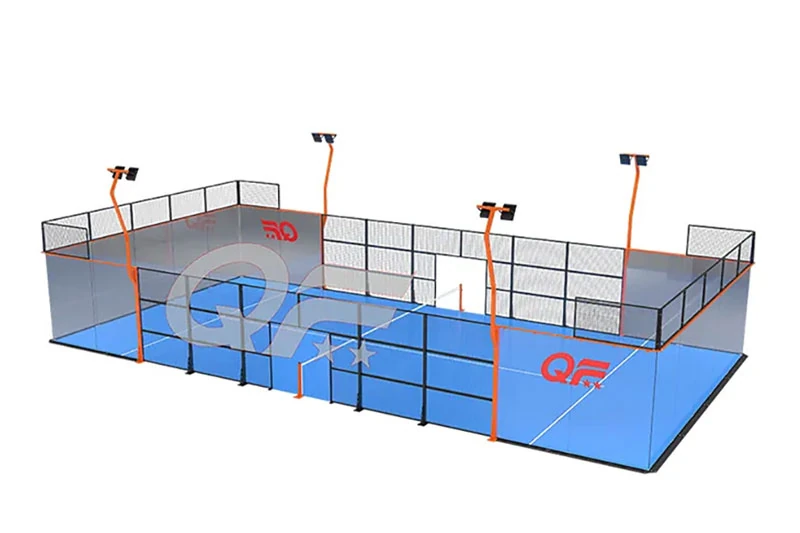
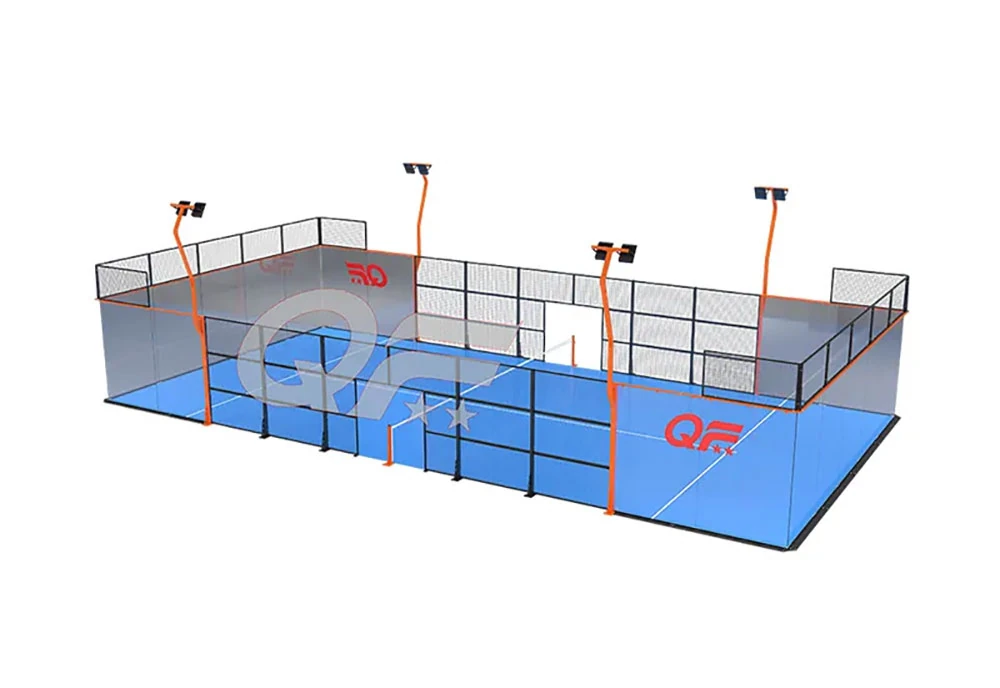
The Qifan PD06 provides a useful example because its main structural and equipment parameters are stated in measurable terms rather than only in general marketing descriptions.
PD06 Core Structure and Equipment Specifications
| Component | PD06 Specification |
| Court size | 20 m × 10 m |
| Artificial turf | 12 mm artificial short grass |
| Sand infill | 120-mesh quartz sand, 5 kg/m² |
| Tempered glass | 2995 × 1995 mm, 12 mm |
| Side columns | 100 × 100 × 3 mm steel pipe |
| Crossbeams | 50 × 100 × 3 mm steel pipe |
| Other columns | 50 × 100 × 3 mm steel pipe |
| LED lighting | 8 × 200 W fixtures |
| Lamp-post height | 6000 mm |
| Illumination | 300 Lux |
| Customization | Supported |
How PD06 Specifications Match Different Project Requirements
A specification table does more than list numbers. It shows how the specifications affect performance, safety, and value.
For spatial planning, the standard 20 × 10 m dimension establishes a tournament-compliant footprint. The surface system—comprising 12 mm artificial short grass paired with 120-mesh quartz sand at 5 kg/m ²—delivers optimized ball bounce, slip resistance, and underfoot comfort, avoiding the excessive slide or high wear typical of inferior turfs.
Regarding structural safety, the 12 mm tempered glass provides a heavy-duty safety barrier that guarantees high impact resistance, which must be evaluated alongside the frame and fasteners. Similarly, instead of vague marketing claims, the PD06 features precise, measurable dimensions: 100 × 100 × 3 mm side columns for maximum rigidity under wind loads, and 50 × 100 × 3 mm crossbeams and auxiliary columns to ensure balanced load distribution.
On the illumination front, the measurable configuration—eight 200 W fixtures mounted on 6000 mm poles delivering 300 Lux—guarantees uniform, glare-free lighting tailored for professional evening play while preventing dark spots. Finally, the built-in customization support ensures the PD06 can be flexibly adapted to unique architectural or environmental demands.
Qifan Manufacturing and Project Support Capabilities
When evaluating padel court manufacturers, buyers should look beyond the product page and assess how the supplier manages manufacturing and project support.
In-house manufacturing:
Qifan’s manufacturing capabilities include steel processing, laser cutting, bending, welding, surface treatment, and assembly. These capabilities can support control over structural components and customized court configurations.
Quality control:
Quality checks can cover steel structures, tempered glass, mesh or fencing, LED lighting, and other core components. Buyers can request relevant inspection records and product documentation as part of the procurement process.
Customization and technical support:
For commercial projects, available support may include court colors, logos, lighting options, foundation solutions, CAD drawings, 3D layouts, installation manuals, remote technical guidance, and after-sales support.
Frequently Asked Questions
Q1: How should I choose between Classic and Panoramic padel courts?
Classic and Panoramic courts differ mainly in structural configuration, glass arrangement, visual openness, and overall design.
For a commercial project, buyers should compare the two configurations according to the intended application, visual requirements, structural design, glass configuration, available space, and budget.
The choice should also be considered alongside the site’s environmental conditions and the manufacturer’s installation recommendations.
Q2: Why is weather resistance especially important for outdoor padel courts?
An outdoor court is continuously exposed to rain, humidity, wind, temperature changes, and, in some locations, coastal salt or snow. These conditions can affect steel corrosion, drainage, glass support components, turf, and other equipment.
For demanding environments, buyers should therefore verify the corrosion-protection system, wind-load design, drainage strategy, and material specifications before purchasing.
Q3: Can an outdoor padel court be installed on grass, sand, rooftops, or uneven ground?
Potentially, yes, but the installation method must match the site.
A modular foundation system may provide an alternative for grass, sand, rooftops, or uneven ground where a conventional concrete foundation is difficult. The manufacturer should confirm suitability after reviewing the actual site conditions and foundation requirements.
Q4: What hidden costs should I consider when buying padel courts for sale?
Do not compare factory prices alone. Include:
- Sea freight
- Container loading
- Port charges
- Customs clearance
- Duties and taxes
- Local transportation
- Unloading
- Foundation construction
- Installation
- Storage
For overseas projects, also clarify the Incoterm and exactly which equipment and services are included in the quoted price.
Q5: What technical specifications should I check before buying an outdoor padel court?
At minimum, review:
- Court dimensions
- Steel structure
- Corrosion protection
- Glass thickness and safety specifications
- Artificial turf
- Sand infill
- Lighting
- Foundation
- Drainage
- Applicable certifications
- Structural documentation
- Wind-load design
A detailed specification makes it easier to compare padel court equipment across manufacturers and identify differences that may not be visible from photographs or headline prices.
Conclusion: Make the Purchase Based on the Complete Project, Not Just the Court Price
Selecting an outdoor padel court should be treated as a complete project decision rather than a simple product purchase. Start with the installation environment and climate, then evaluate the structural design, corrosion protection, glass, turf, lighting, foundation, drainage, and total project cost. For overseas projects, applicable standards and technical documentation should also be verified before ordering.
The PD06 example shows why measurable specifications are valuable during procurement. Dimensions, steel profiles, glass thickness, turf, lighting, and customization give buyers concrete points for comparison. The right padel court manufacturer should also be able to support the project with technical documentation, customization, engineering assistance, and after-sales support.
If you already have a project site, target quantity, preferred court type, or installation requirements, request a custom offer based on your actual project conditions rather than comparing standard factory prices alone.
Share your site location, layout requirements, or target quantities with Qifan , and let our engineering team translate your project scope into a tailored, transparent quotation.