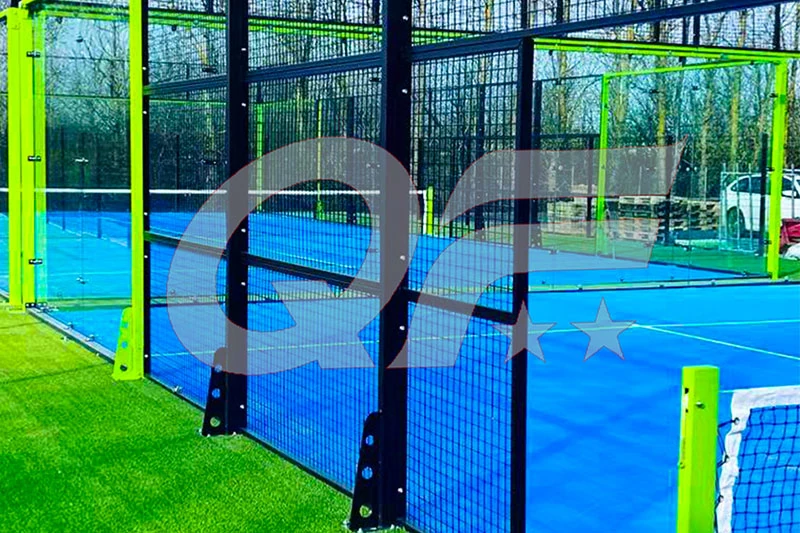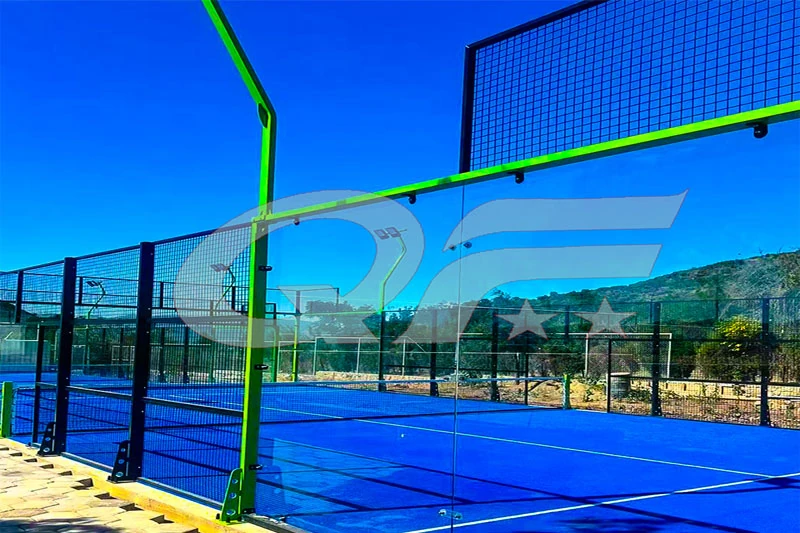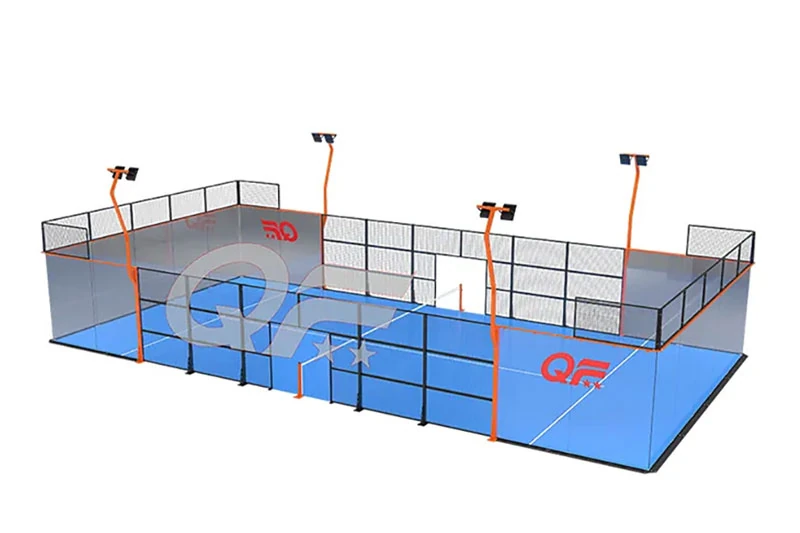
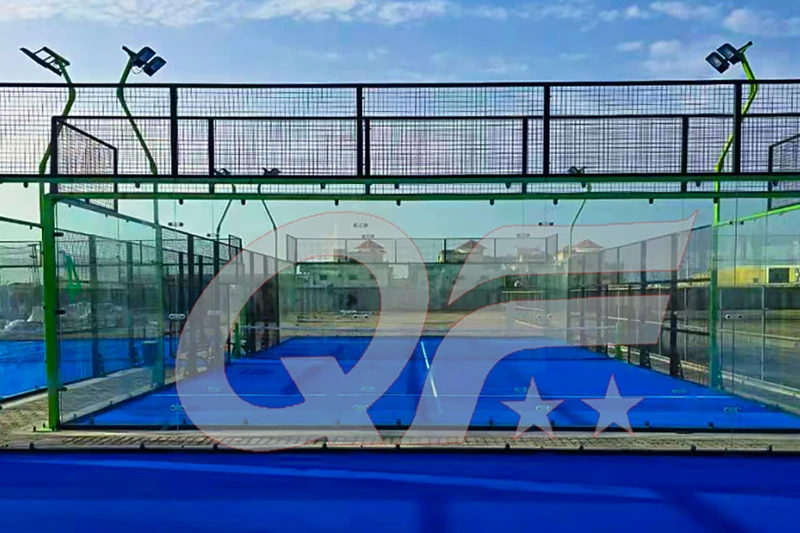
Tennis, as a traditional racket sport, boasts a history of over a century, while padel, as an emerging sport, is capturing market share at an astonishing pace. For sports facility operators, hotel managers, and property developers, understanding the fundamental differences between these two court types in terms of size, design, cost, and installation is essential before making any capital investment decision. This article provides a comprehensive and objective comparison of padel courts and tennis courts across multiple dimensions.
1. Standard Padel Court Size vs Tennis Court Size
Standard Padel Court Dimensions (20m × 10m)
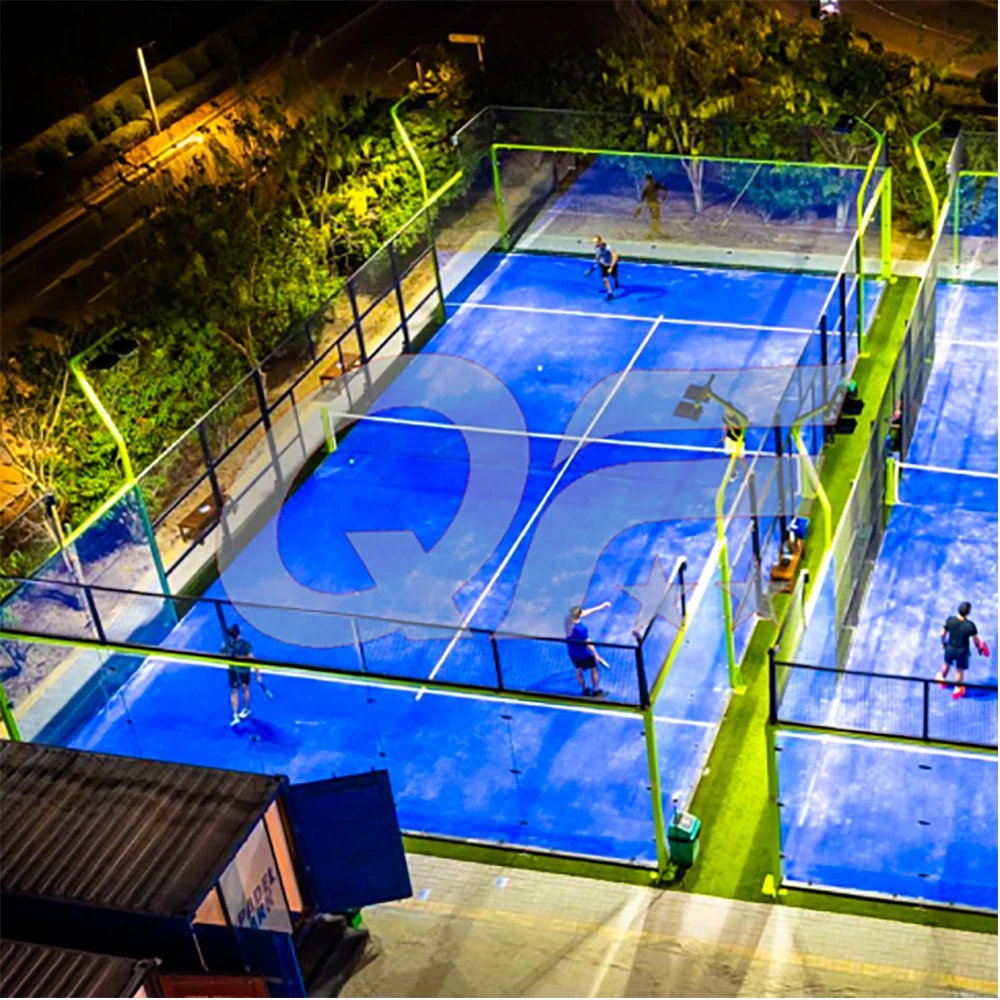
The standard padel court measures exactly 20 meters long and 10 meters wide, with a total playing area of 200 square meters. This compact footprint is a core factor driving padel’s commercial appeal. The recommended total footprint, including safety run-offs, is approximately 24 meters by 14 meters, or about 336 square meters.
This efficient dimension allows padel courts to flexibly adapt to various spaces—from unused warehouses and convention centers to hotel gyms and school gymnasiums—all of which can easily accommodate them.
Standard Tennis Court Dimensions
A standard singles tennis court measures 23.77 meters long and 8.23 meters wide, with a playing area of approximately 195.6 square meters—quite close to that of a padel court. However, for doubles play, the width extends to 10.97 meters, bringing the playing area to approximately 260.8 square meters.
However, the playing area does not tell the whole story in terms of actual space requirements. The International Tennis Federation (ITF) mandates substantial run-off areas for professional or club-level courts—at least 6.40 meters behind each baseline and 3.66 meters on each side. This brings the recommended total footprint to approximately 36.6 meters by 18.3 meters, or about 670 square meters. Additionally, tennis courts typically require spectator seating, perimeter fencing, and access pathways.
Space Requirements for Indoor and Outdoor Projects
| Comparison Dimension | Padel Court | Tennis Court |
| Playing Area | 200㎡ (20m × 10m) | Singles 195.6㎡ / Doubles 260.8㎡ |
| Recommended Footprint (incl. run-offs) | Approx. 336㎡ (24m × 14m) | Approx. 670㎡ (36.6m × 18.3m) |
| Number of Courts in Same Area | Approximately 2 courts | 1 court |
This significant difference directly impacts project site flexibility and land costs. In urban settings or indoor spaces, the compact padel court size enables developers to install more courts within the same footprint, creating higher revenue potential per square meter.
2. Padel Court Design vs Tennis Court Design
Enclosure Structure: Glass Enclosure vs Open Court
Padel courts feature a fully enclosed structure. The perimeter consists of tempered glass and metal mesh fencing, with end walls and rear walls typically made of transparent glass and side walls combining glass and mesh. This design not only keeps the ball effectively within the court but also creates the unique “wall rebound” gameplay while providing spectators with clear viewing sightlines. Standard padel courts have a perimeter fence height of 4 meters, with both end and side walls constructed from high-strength tempered glass featuring excellent impact resistance.
Tennis courts are fully open in design, with no enclosing walls around the perimeter (only protective fencing installed around the court to prevent balls from flying out). The ball is dead when it goes out, with no tactical dimension of wall rebounds. Protective fencing typically stands 3 to 4 meters high and serves only as a barrier, not as part of the game.
Court Surface: Artificial Turf vs Hard Court/Clay/Grass
Padel courts almost exclusively use artificial turf as the playing surface. The standard configuration is 12mm artificial short grass with quartz sand infill (typically 120-mesh quartz sand at approximately 5kg/㎡) to provide consistent ball speed, bounce height, and underfoot comfort for players. The artificial turf also offers excellent drainage performance, suitable for year-round outdoor use.
Tennis courts feature a diverse range of surface materials, falling into three main categories:
Hard Court (acrylic coating): The most common type, used at the US Open and Australian Open. Construction is complex, requiring multiple coating layers and extremely high flatness standards.
Clay (crushed brick): Used at the French Open. Maintenance costs are high, requiring regular watering, rolling, and replenishment of surface material.
Natural Grass: Used at Wimbledon. This is the most expensive surface to maintain, requiring professional turf management and having a limited playing life.
Lighting System Configuration Differences
Both court types require high lighting standards, but the specifications differ.
Padel courts are typically equipped with 8 sets of 200W LED lighting fixtures, with poles integrated into the fence structure at a mounting height of 6 meters, providing 300 Lux of uniform illumination across the entire court. The LED system features low energy consumption, long service life, and instant-on capability with no warm-up time required.
Tennis courts have stricter lighting requirements—professional competition standard requires 500 Lux or more, typically using higher-wattage metal halide or LED floodlights mounted on independent poles positioned at the four corners of the court, with pole heights reaching 8 to 12 meters. Power consumption and installation costs are significantly higher than those for padel courts.
Installation Method: Modular vs On-Site Construction
Padel courts adopt a modular design approach. All components are prefabricated at the factory—steel structure cutting, welding, and coating are completed off-site, while glass and fencing are manufactured to standard sizes. On-site work is limited to assembly and connection. This “plug-and-play” approach dramatically shortens installation timelines.
Tennis courts rely on on-site construction. Hard court construction involves site excavation, crushed stone base layer, concrete pouring, leveling course, and multiple acrylic coating applications—each requiring curing time and all subject to weather conditions. The construction cycle is measured in weeks or even months.
3. Padel Court Cost vs Tennis Court Cost
Initial Construction Cost
Padel courts require significantly lower initial investment than tennis courts. Key reasons include:
Smaller footprint, reducing land or indoor space costs
Steel and glass systems are factory-prefabricated for efficient on-site assembly
Minimal ground preparation—only leveling and hardening before turf installation
Lower lighting power requirements and simpler electrical distribution
Tennis courts involve substantially higher initial construction costs. Hard court surface construction requires multiple materials and layers, while clay and grass courts are even more expensive to build. Independent lighting poles, more complex drainage systems, and larger footprints all drive up total investment.
Installation Time and Labor Requirements
Padel court modular installation is typically completed within a matter of days. On-site work requires minimal specialized labor, primarily component assembly and fastening.
Tennis court on-site construction takes weeks or even months. Concrete pouring and curing, along with acrylic coating drying, all require time and are subject to weather conditions. Labor costs and project delay risks are far higher than for padel courts.
Maintenance and Operating Costs
Padel courts require relatively simple routine maintenance:
Artificial turf needs periodic brushing and sand redistribution to maintain consistent bounce
Tempered glass requires only regular cleaning
LED lighting systems have long service lives with low replacement frequency
Steel structures do not require regular repainting
Tennis court maintenance costs vary by surface type:
Hard courts require periodic resurfacing (typically every 4–8 years) at significant expense
Clay courts require daily watering, rolling, and surface replenishment—labor-intensive work
Grass courts require professional mowing, irrigation, and pest management at extremely high costs
Verified operational data shows that padel courts reduce annual energy consumption by 23% compared to traditional tennis facilities, with annual maintenance costs reduced by 15%.
4. Which Court Is Easier to Install
Modular Padel Court Installation Process
Padel court installation is centered on on-site assembly of prefabricated components:
Ground base preparation—simple leveling and hardening only
Column installation—fixed at designated positions
Beam and mesh frame connection—bolted together
Tempered glass panel installation
Artificial turf laying and quartz sand infill
LED lighting system installation and commissioning
The entire process is highly standardized, with minimal weather dependence. General construction teams can operate effectively with basic training.
Tennis Court Construction Process
Tennis court construction is a multi-stage, long-cycle, weather-dependent project:
Site excavation and drainage system installation
Crushed stone base layer compaction
Concrete or asphalt base pouring and curing
Multiple acrylic surface coating applications (each requiring drying and curing)
Court line marking
Fencing and independent lighting pole installation
Delays at any stage (rain, low temperatures, etc.) will extend the overall timeline.
Key Factors Affecting Installation Time
| Factor | Padel Court | Tennis Court |
| Weather Dependence | Low—prefabricated on-site assembly | High—pouring and coating require dry weather |
| Base Preparation | Simple hardening | Complex multi-layer structure |
| On-Site Wet Work | None | Required (concrete pouring, coating application) |
| Curing Time | None required | Concrete curing + coating drying—days to weeks |
| Construction Cycle | Days | Weeks to months |
5. PD04 Panoramic Padel Court: A Professional Solution
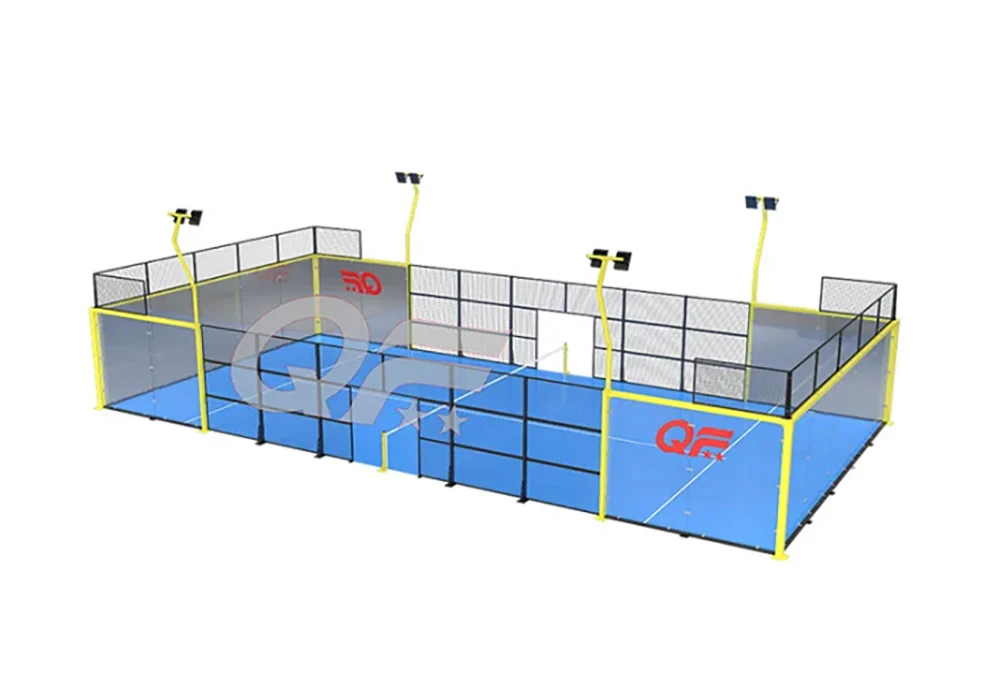
Based on the above comparison and standards analysis, the following presents the PD04 Panoramic Padel Court as an example of a complete professional padel court solution.
Hot-Dip Galvanized Steel Structure: 8-Year Rust Protection, 12+ Year Service Life
The PD04 is manufactured from high-strength steel, with all steel components undergoing internal and external hot-dip galvanizing followed by electrostatic powder coating through an automated curing line. This process ensures up to 8 years of rust protection under normal outdoor conditions.
Structural specifications include corner columns of 100mm × 100mm × 3mm, crossbeams of 50mm × 100mm × 3mm, and mesh frames of 30mm × 50mm × 2mm welded with 3mm steel plates. The structural design complies with GB 50429-2007 standards, meeting strength and deflection requirements for normal outdoor use. Overall service life exceeds 12 years—over 4 years longer than standard products.
12mm Tempered Safety Glass System
The PD04 features specially manufactured explosion-proof tempered glass, with individual panel dimensions of 2995mm × 1995mm and thickness of 12mm. The glass enclosure system incorporates cushioned connection components to enhance impact resistance and safety. Glass deformation performance meets Level 15 deformation requirements, with wind resistance up to Level 16–17, achieving an optimal balance between panoramic visibility and structural safety.
Professional Artificial Turf and Quartz Sand Infill System
The PD04 panoramic padel court uses 12mm artificial short grass compliant with GB/T 20394-2013 “Artificial Grass for Sports” premium product standards. Infill material is 120-mesh quartz sand applied at 5kg/㎡ with uniform distribution. This system delivers consistent ball speed, uniform bounce height, underfoot player comfort, and efficient drainage performance.
LED Lighting System: 300 Lux Uniform Illumination
The PD04 is equipped with 8 sets of 200W LED lighting fixtures, with poles integrated into the fence structure at a mounting height of 6000mm. The system provides 300 Lux of uniform illumination across the entire court, meeting professional training and recreational play standards. The LED system offers low energy consumption, long service life, and instant-on capability.
Modular Connection System: Fast Installation
The PD04 uses standardized modular components with high-strength fasteners. All components are prefabricated at the factory, requiring only on-site assembly. This design enables fast installation, easy transportation, and reliable structural stability.
Manufacturing Process Advantages
The PD04 manufacturing process reflects precision engineering standards:
Laser cutting and bending: Ensures precise dimensional tolerances
Robotic + manual welding: Full weld coverage ensuring structural integrity
Shot blasting: Removes surface oxidation for ideal coating adhesion
Electrostatic powder coating + automated curing line: Uniform coating with excellent corrosion protection
Strict quality control: Covers glass, lighting, and steel throughout the production process
Export-grade packaging: Minimizes transport damage
Competitor Comparison
| Comparison Dimension | PD04 Panoramic Padel Court | Standard Competitor |
| Tube Material | Galvanized square tube (inside & outside) + SPHC steel | Ordinary steel tube, lower corrosion resistance |
| Processing Method | Laser cutting + bending, robotic + manual full-weld | Manual cutting, traditional welding and coating |
| Surface Treatment | Shot blasting + electrostatic powder coating + automated curing line | Traditional spray coating |
| Quality Control | Strict QA covering glass, lighting, and steel | Loose QA with basic packaging |
| Service Life | 12+ years | 8–10 years |
| Key Advantage | High corrosion resistance, precision manufacturing, strong welds, uniform coating, superior rust protection | Basic functionality, shorter lifespan |
Suitable Applications
The PD04 is designed for diverse and demanding environments:
Coastal and high-humidity areas: Corrosion-resistant galvanized steel with powder coating
Extreme temperature regions: Materials maintain stable performance in hot and cold climates
High-wind areas: Reinforced structure for excellent stability
Heavy usage facilities: Durable steel frame and tempered glass for long-term high-frequency use
6. Case Study: Warehouse Converted into a Commercial Padel Club
Customer Challenges
A UK sports operator planned to transform an unused warehouse into a commercial Padel Club. The project presented multiple challenges:
Space utilization: Maximize the number of courts within the limited warehouse footprint
Construction costs: Control renovation expenses to ensure financial feasibility
Fast operation: Open quickly to generate revenue and shorten the payback period
PD04 Panoramic Padel Court Solution
The operator selected the PD04 Panoramic Padel Court solution with the standard padel court size of 20m × 10m. The panoramic glass structure, hot-dip galvanized steel frame, and professional artificial turf system were installed within the warehouse shell. The modular connection system enabled rapid, efficient installation with minimal modifications to the original warehouse structure.
Project Results and Business Benefits
Upon completion, the unused warehouse was successfully transformed into a modern Padel Club:
Efficient space utilization: Achieved optimal court layout within the warehouse footprint
Fast opening: Modular installation dramatically shortened the timeline from construction to operation
Low-maintenance operations: Weather-resistant materials reduced routine maintenance workload
Premium positioning: Panoramic glass and modern design elevated the club’s market position
Strong business potential: High utilization rates and member satisfaction validated project success
This case demonstrates the practical value of modular padel court solutions in space renovation projects.
7.FAQ
Q1: How long does a Padel Court installation take?
A: With a modular structure and prefabricated components, installation can usually be completed quickly depending on site conditions.
Q2: What maintenance does a Padel Court require?
A: Regular cleaning of glass panels, artificial turf maintenance, and inspection of steel connections are recommended to ensure long-term performance.
Q3: Can the Padel Court be installed outdoors in harsh weather conditions?
A: Yes. The galvanized steel structure and powder coating provide corrosion resistance, making it suitable for outdoor environments.
Q4: Can the Padel Court be customized?
A: Yes. We provide customization options including colors, lighting systems, glass design, and structural solutions.
Q5: What type of foundation is required?
A: A flat and stable concrete foundation is required. Specific requirements depend on local conditions and project design.