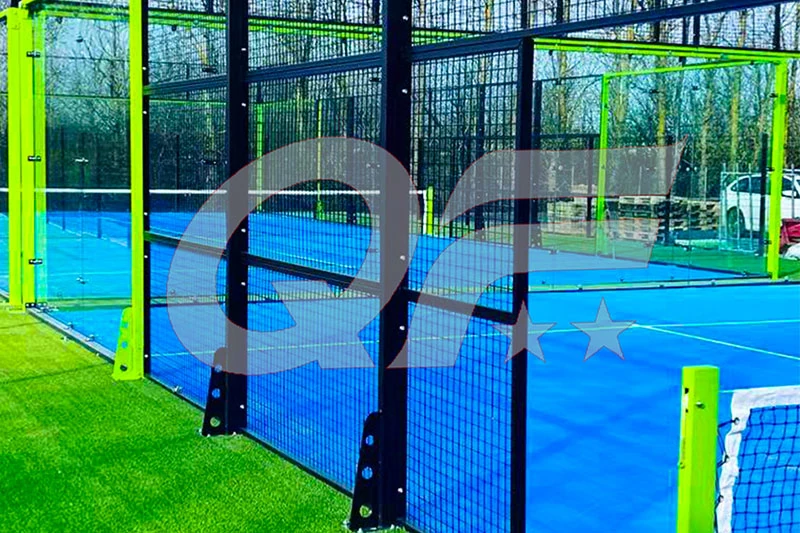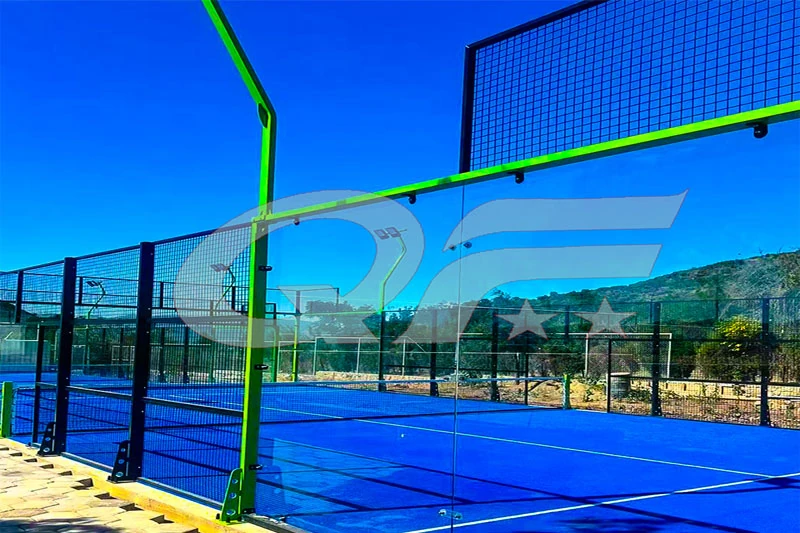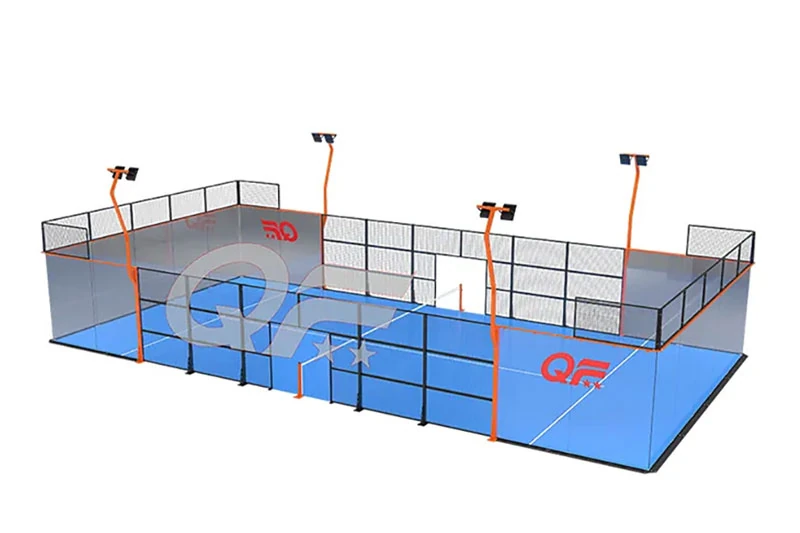
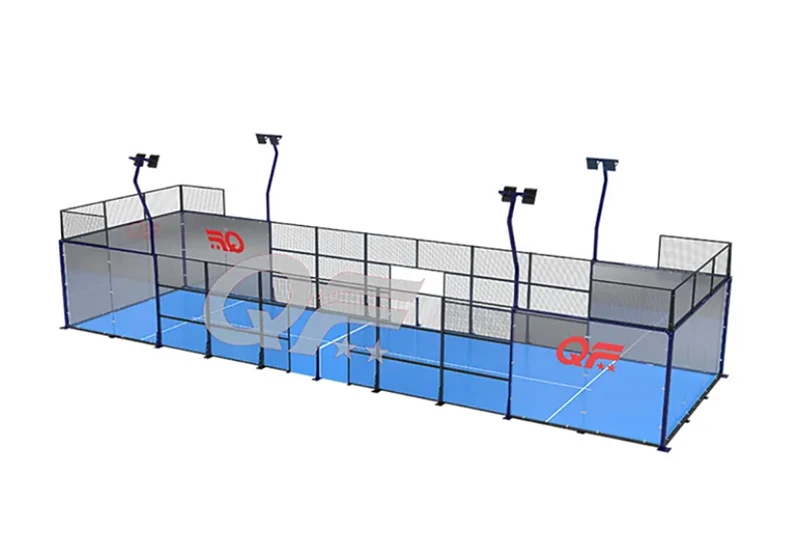
For small sports projects, available space and initial budget can quickly limit the choice of Padel court. A standard 20m × 10m double court may not be suitable for every gym, hotel, commercial property, or small sports facility. In these situations, a 20m × 6m single Padel court provides a more compact way to introduce Padel without requiring the same amount of space as a standard double court.
A single Padel court is designed for two players, making it suitable for 1v1 play and private coaching as well as smaller recreational projects. Its smaller footprint can also help businesses make use of available areas that may not be large enough for a standard double court.
For investors and facility operators, this smaller project size can mean a lower initial commitment and a practical way to test local demand before considering a larger Padel development.
What Is a Single Padel Court?
A single Padel court is designed for two-player play rather than the four-player format used for standard double Padel courts.
A typical single court has a playing area of 20m × 6m, or approximately 120 square meters. A standard double Padel court measures 20m × 10m, with an area of approximately 200 square meters.
The difference in size is significant for projects where available space is limited. A small padel court can be considered for gyms, hotels, small sports facilities, commercial properties, and other locations where a standard double court may require more space than the project can provide.
The two-player format also creates different opportunities for 1v1 play, private coaching, and smaller recreational projects.
Single Padel Court vs. Standard Double Padel Court
| Comparison Factor | Single Padel Court | Standard Double Padel Court |
| Court Size | 20m × 6m, approx. 120㎡ | 20m × 10m, approx. 200㎡ |
| Players | 2 players | 4 players |
| Main Applications | 1v1 play, private coaching, small-space projects | Standard games, four-player social play |
| Initial Investment | Lower requirements for materials and construction | Baseline investment |
| Suitable Projects | Gyms, hotels, rooftops, unused commercial areas | Dedicated Padel clubs and large sports parks |
The choice between the two configurations depends on the project’s available space, target users, and business objectives. A standard double court may be a better fit for dedicated Padel clubs and larger sports facilities, while a single court can be considered for smaller projects with more limited space.
Why Choose a Single Padel Court for Small Sports Projects?
1. Better Space Utilization
For a small sports project, the available site can be the first limitation. A standard single Padel court measures 20m × 6m, requiring approximately 120 square meters of court area. Compared with a 20m × 10m double court, this smaller footprint gives businesses more options when working with limited space.
It can also make use of areas that may otherwise be difficult to develop into a sports facility. For example, unused areas in commercial complexes, parts of warehouses, corners of gyms, and hotel backyards may be considered for a single Padel court, provided that the site meets the necessary installation and structural requirements.
The smaller footprint can also reduce the area needed for related site preparation and foundation work. For projects with suitable existing conditions, this can help simplify site planning and may contribute to a shorter construction timeline compared with a larger court project.
2. Lower Initial Investment
Padel court investment is closely related to the size and scope of the project. Compared with a large double-court or multi-court development, a single court generally requires less material and installation work. This can reduce the amount of steel framing, glass, artificial turf, and construction labor required for the initial project.
For investors entering a new Padel market, a single court can work as a pilot project. Instead of committing a large amount of capital to a multi-court facility, investors can start with one court and use actual customer demand, booking activity, and coaching interest to assess how well Padel is accepted in the local market.
This approach does not guarantee a faster return on investment, but it can help investors limit their initial exposure and make expansion decisions based on real market performance.
3. Easier Player Matching and Private Coaching
A standard Padel doubles game requires four players, which means players need to coordinate with three other people before they can start a game. A single court requires only two players, lowering the barrier to organizing a session and making 1v1 play easier to arrange.
This can be particularly useful for operators who want to offer private coaching and individual training. A coach and one player can use the court without needing additional participants, making it easier to schedule dedicated training sessions. For facilities with regular demand for coaching, these sessions can provide an additional revenue stream alongside court rentals.
A single court can also support a more private playing experience. For gyms, hotels, and membership-based sports facilities, it may be used for private sessions, premium bookings, or VIP activities, depending on the facility’s operating model. This gives operators more flexibility in designing services for different customer groups rather than relying only on standard four-player bookings.
4. Flexible Design and Construction for Different Sites
A single Padel court is not only about having a smaller footprint. The court structure also needs to match the conditions of the installation site. For indoor projects, the design can be adapted to the available ceiling height, while outdoor projects need to take local wind conditions into account.
Material selection is another important part of the project. High-quality steel structures, tempered glass, and professional artificial turf form the main components of the court and can directly affect the overall construction quality and playing environment.
For small projects, these details are particularly important because the court may need to fit into an existing building, rooftop, backyard, or other space with specific structural limitations. A suitable design and material specification can make it easier to adapt the court to the actual site rather than treating every project as the same standard installation.
Where Can a Single Padel Court Be Used?
Gyms and Fitness Centers
A gym can use a single court to add Padel as a new activity without dedicating as much space to the project as a standard double court would require.
This can be particularly relevant for facilities that already have most of their available space occupied by fitness equipment and other services.
Hotels and Resorts
Hotels and resorts can consider a single Padel court as an additional recreational facility.
A compact court may be easier to integrate into a suitable outdoor area or other available part of the property. Site conditions and structural requirements should be checked before installation.
Commercial and Mixed-Use Spaces
Commercial properties may have unused areas that could potentially be converted into recreational facilities.
A small court can provide an option for introducing Padel where the available area is not large enough for a standard double court.
Small Sports Facilities and Pilot Projects
For smaller sports facilities and businesses entering the Padel market, a single court can provide a starting point for testing customer demand.
It can also be considered when the main focus is 1v1 play, private coaching, or smaller-scale recreational use.
Key Factors to Consider for Single Padel Court Construction
Available Space and Site Planning
Before beginning padel court construction, buyers should confirm that the proposed site can accommodate the 20m × 6m court and the surrounding requirements for installation and use.
The available space, access, surrounding structures, and installation conditions should all be checked before finalizing the court layout.
Frame and Structural Requirements
The frame is an important part of a Padel court’s overall structure. Buyers should consider the material and structural design according to the intended installation environment.
For outdoor projects, local wind conditions should also be considered. The structural requirements of an indoor project may differ depending on the building and installation conditions.
Tempered Glass and Court Enclosure
The glass enclosure is another important component of the court system.
Buyers should compare glass thickness, panel dimensions, structural support, and the overall enclosure design when evaluating different court solutions.
Artificial Turf and Surface Requirements
The playing surface directly affects the court system and should be evaluated as part of the overall specification.
When comparing suppliers, buyers can review the turf type, thickness, relevant standards, sand filling requirements, and installation specifications rather than looking at the court structure alone.
Lighting and Customization
Lighting should also be considered for projects that plan to operate the court during evening hours or in areas where additional illumination is required.
Customization may be useful when the court needs to match specific site conditions, structural requirements, or project preferences.
Single Padel Court PD07 for Small-Space Sports Projects
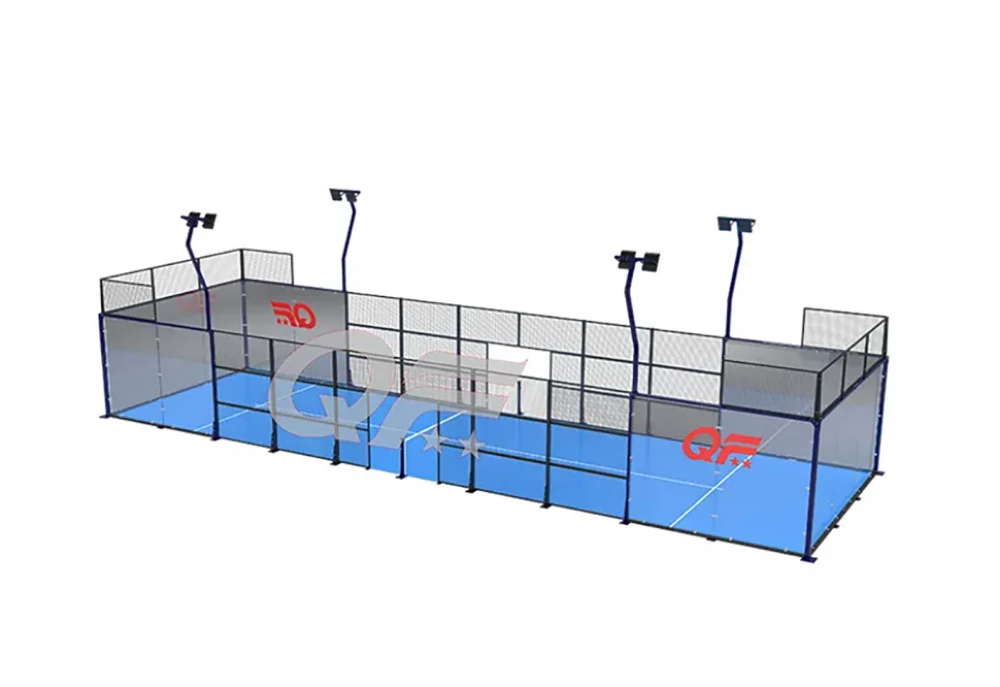
For projects that need a compact Padel court without moving to a standard 20m × 10m double-court configuration, the Single Padel Court PD07 provides a 20m × 6m court design. The configuration is suitable for projects where available space is limited and where the court needs to be adapted to specific installation requirements.
The playing surface uses 12mm artificial short grass in compliance with GB/T 20394-2013 “Artificial Grass for Sports” premium product. The surface is filled with 120-mesh quartz sand at 5kg per square meter, with uniform sand filling required. These specifications provide a defined surface configuration for the court rather than treating the turf as a simple finishing material.
Structural Design and Enclosure
The PD07 uses HDG steel or aluminum for the frame, providing two material options for different project requirements. The product supports customization, with a stated 20–30m customizable span, allowing the structure to be considered according to the installation conditions.
For outdoor applications, the specified wind load is up to 120km/h. This is particularly relevant when planning a court in an exposed outdoor location, where the structural design needs to account for local wind conditions.
The enclosure uses specially made explosion-proof tempered glass with a thickness of 12mm. Each glass panel measures 2995mm × 1995mm. For buyers comparing Padel court suppliers, glass thickness, panel dimensions, and structural support are important specifications to review as part of the complete court system.
Lighting Configuration
The PD07 is equipped with 8 LED lights, with each light rated at 200W. The lamp posts are embedded inside the fence and have a height of 6000mm. The specified illumination reaches 300 Lux.
This integrated lighting configuration is part of the overall court design and should be considered when planning the installation environment, particularly for projects that require a complete court system rather than a basic court structure.
Customization for Different Projects
Different sites can have different space and structural conditions. The PD07 supports customization, allowing buyers to discuss the court configuration according to their project requirements.
For a small gym, hotel, commercial space, or other compact sports project, the 20m × 6m configuration provides a defined starting point for site planning. At the same time, the available options for frame materials, structural customization, turf, glass, and lighting specifications give project buyers several key elements to evaluate when planning the court.
For B2B buyers, the main value of the PD07 is therefore not a single specification, but the combination of compact court dimensions, defined material standards, structural options, tempered glass, artificial turf, integrated lighting, and customization support in one Padel court solution.
Conclusion
A single Padel court can be a practical option for small sports projects where space, initial investment, and player capacity are important considerations.
With a 20m × 6m configuration, it occupies less court area than a standard 20m × 10m double court and can be considered for gyms, hotels, commercial properties, small sports facilities, and pilot projects.
For businesses planning padel court construction, the decision should also take into account the frame, glass enclosure, artificial turf, lighting, site conditions, and customization requirements.
For projects that need a more compact Padel solution, the Single Padel Court PD07 provides a 20m × 6m configuration with customizable structural options and specified turf, glass, frame, lighting, and wind-load specifications.
Looking for a single Padel court for your project? Contact us to discuss your site requirements and customization options.
Frequently Asked Questions
1. What is the size of a single Padel court?
A single Padel court typically measures 20m × 6m, with an area of approximately 120㎡.
2. How many players can use a single Padel court?
A single Padel court is designed for 2 players, making it suitable for 1v1 play and private coaching.
3. Is a single Padel court suitable for small projects?
Yes. Its compact size makes it suitable for gyms, hotels, commercial spaces, and small sports facilities with limited available space.