Key Takeaways
- The standard padel court size follows the standard format, but clubs also need to allow sufficient space for clearance, circulation, access, maintenance and safety.
- Padel court glass should be selected based on the glass type and thickness, support structure, fixing method and expected level of use.
- For regular club use, medium-thickness artificial turf with suitable quartz sand infill is a common configuration. Fiber type, density and installation method should also be considered.
- Daily club use generally requires practical and evenly distributed lighting, while professional competitions need higher illumination and tighter uniformity, especially for high-definition recording and live broadcasting.
- Outdoor projects require suitable foundation, drainage, wind-resistance and corrosion-protection measures based on site conditions.
- A complete quotation should clearly define the court structure, glass, turf, quartz sand, lighting, foundation and installation requirements, as well as delivery, warranty and after-sales support.
Introduction
Choosing a padel court for a club involves more than checking the standard dimensions. A commercial court may be used for several hours a day, so the materials and configuration need to match the expected traffic and operating conditions.
The site also affects the final specification. Court dimensions must accommodate player movement and safety clearance. Glass needs to provide suitable strength and visibility. Artificial grass affects traction and ball response, while lighting determines how comfortably players can use the court after dark. Outdoor courts also require proper drainage, anchoring and corrosion protection.
For this reason, clubs should define the complete configuration before comparing quotations. This guide explains the main specifications to review when sourcing a super padel court for a club project.
What Padel Court Size Does a Club Need?
Standard Padel Court Size
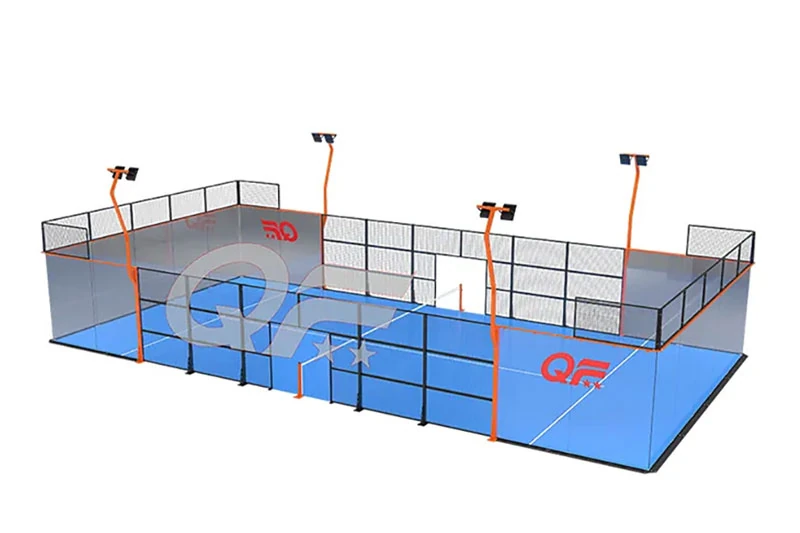
Clubs should plan the court together with access, player circulation, maintenance space and other facility requirements. This becomes even more important when several courts are installed at the same venue.
Vertical clearance also needs attention. A minimum unobstructed height of 6 m is recommended above the court, while 10 m is preferred for higher-level play, particularly where high lobs are expected.
If a club plans to host events, the space outside the court should also be considered. The padel court size is therefore only the starting point. A practical site plan should leave enough room for movement, entrances, maintenance and lighting without making the court area feel crowded.
How to Choose Padel Court Glass and Artificial Grass?
Glass and artificial grass have a direct effect on the playing environment. For club projects, buyers should evaluate their specifications together with the supporting frame and expected level of use.
Padel Court Glass: Thickness and Safety
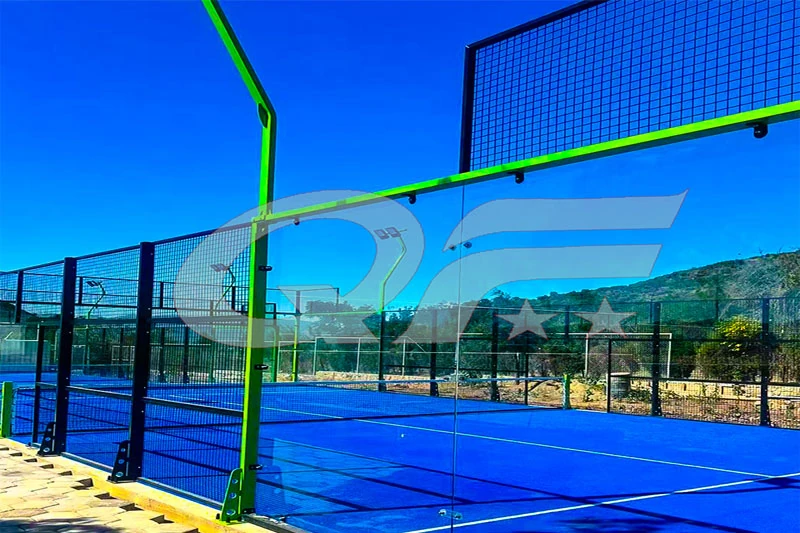
High-strength tempered safety glass is commonly used for padel courts. 12 mm tempered glass is a standard configuration. For super or competition-level courts, 12 mm tempered glass or 6+6 mm laminated glass can also be used.
Laminated construction can help contain glass fragments if breakage occurs. However, thickness alone should not determine the purchase decision. Glass quality, support structure, fixing method and the intended use of the court should also be checked.
For clubs that place greater emphasis on visibility, panoramic designs can provide a more open viewing area. Super courts can use high-load bases and concealed connections to reduce visible corner structures.
Artificial Grass and Quartz Sand
Artificial grass should match the traffic level and playing requirements of the club. Curled monofilament turf is often preferred for club-level courts. Its structure allows quartz sand to settle around the base of the fibers, helping maintain traction and surface stability.
Turf height is usually around 10–12 mm, with higher-density fibers providing better resistance to regular wear. Quartz sand should be rounded, dry and suitable for sports turf. It also needs to be distributed evenly across the surface.
Rather than comparing turf by height alone, buyers should look at the complete surface specification, including fiber type, density, sand quantity and installation method.
What Lighting Does a Club Padel Court Need?
Lighting affects both playing comfort and the number of hours a club can operate its courts.
Recommended Lighting Level for Club Use
For daily club and recreational use, a practical lighting level with good uniformity is generally sufficient. Professional competitions require higher illumination and more consistent lighting, especially when high-definition recording and live broadcasting are involved.
This means clubs should first define how the court will be used. A venue focused on member play may not need the same lighting specification as a facility designed to host professional competitions.
Lighting Layout and Glare Control
The lighting design should cover more than fixture wattage. The mounting position, beam angle and lens design should be considered together to reduce glare when players look upward at the ball.
For a club project, the supplier should provide the lighting layout and explain how illumination and glare have been considered. This gives buyers a more useful basis for comparison than wattage alone.
What Should Clubs Check Before Installing an Outdoor Padel Court?
Outdoor courts need a suitable foundation and protection against weather exposure. These requirements should be confirmed before production begins.
Foundation Flatness and Drainage
The foundation needs to provide a stable and sufficiently flat surface. Porous or permeable concrete can be used for outdoor courts, while asphalt is also suitable with an appropriate drainage slope.
Flatness is also important. The recommended tolerance is no more than 3 mm over a 3 m straightedge. Excessive unevenness can make glass installation more difficult and may affect turf wear and ball movement.
For premium club projects, a 3–5 mm elastic rubber pad below the turf is an option for improving impact absorption.
Wind Resistance and Corrosion Protection
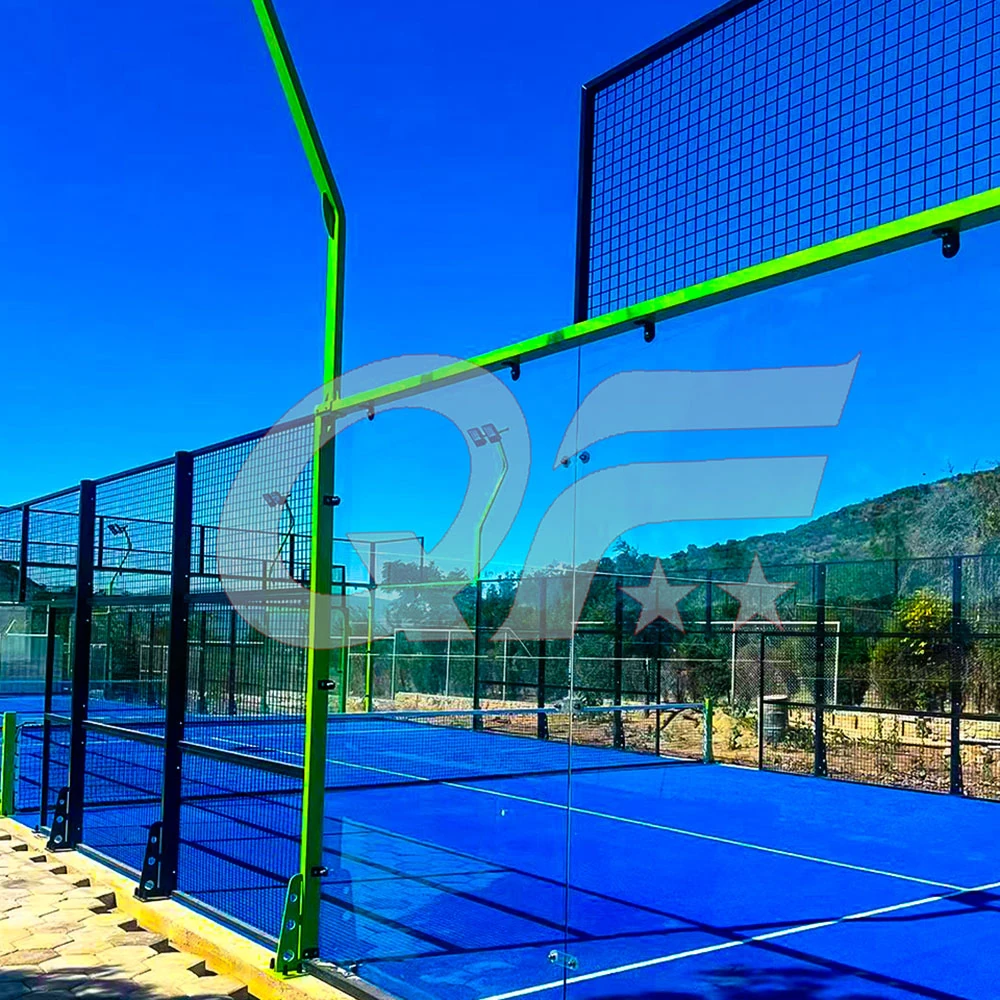
Outdoor panoramic courts have large glass and mesh surfaces, so the frame and anchoring design need to account for local wind conditions. Structural steel of 3–4 mm or thicker is recommended for outdoor panoramic courts, while foundation embedment and concrete requirements should be determined through structural calculations.
Corrosion protection is equally important, especially in coastal or humid environments. Hot-dip galvanizing with a zinc layer of 80 μm or more is recommended, followed by an outdoor protective coating such as UV-resistant polyester powder coating or fluorocarbon paint.
When requesting a quotation, buyers should therefore ask for the steel treatment, coating specification and anchoring requirements instead of treating the frame as a single generic component.
Why Choose Qifan as Your Padel Court Manufacturer?
For a commercial club, the padel court manufacturer influences more than the court itself. Production capacity, customization, installation support and international delivery can all affect project execution.
Manufacturing Capacity and Quality Management
Hebei Qifan Sports Industry Co., Ltd. was established in 2013 and operates a 46,000 m² manufacturing facility with more than 220 professionals. We have delivered projects in more than 50 countries.
Our manufacturing operation uses automated production lines and laser-cutting technology. Its listed management certifications include ISO 9001, ISO 14001 and ISO 45001.
For club buyers, these details can help assess whether a manufacturer has the production and quality management capabilities needed for commercial projects.
Customization and Project Support
Club projects may require different court colors, branding or lighting configurations. Our padel court range supports customization, including powder-coat colors, logo integration and specialized lighting. Our team can also adapt designs to site dimensions and architectural requirements.
At Qifan, we provide a one-stop service covering site surveys, logistics, installation and final handover. Our after-sales support includes technical guidance, spare parts and a three-year warranty to support customers after installation.
Qifan PD10 Super Padel Court for Club Projects
The Qifan PD10 Super Padel Court provides a defined configuration for clubs that need a standard-size court with integrated lighting.
PD10 Key Specifications
| Item | PD10 Specification | Function & Benefit |
| Court Size | 20 × 10 m | Meets the standard doubles court size and suits regular club use and events |
| Artificial Grass | 12 mm | Provides a stable playing surface for frequent use |
| Quartz Sand | 5 kg/m² | Helps hold the grass fibers in place and improve surface stability |
| Glass | 12 mm tempered glass | Provides good impact resistance while maintaining clear court visibility |
| Corner Columns | 100 × 100 × 3 mm | Provide primary support for the court frame |
| Crossbeams | 50 × 100 × 3 mm | Strengthen frame connections and overall structural stability |
| Other Columns | 50 × 100 × 3 mm | Support the glass and mesh sections of the court |
| Mesh | 50 × 50 mm | Helps keep the ball within the court and provides complete enclosure |
| Lighting | 8 × 200 W LED | Provides lighting for evening play and regular club operation |
| Light Pole Height | 6,000 mm | Provides a suitable mounting height for wider lighting coverage |
| Illumination | 300 Lux | Suitable for regular club and recreational use |
| Customization | Available | Allows the court configuration to be adapted to specific site and branding requirements |
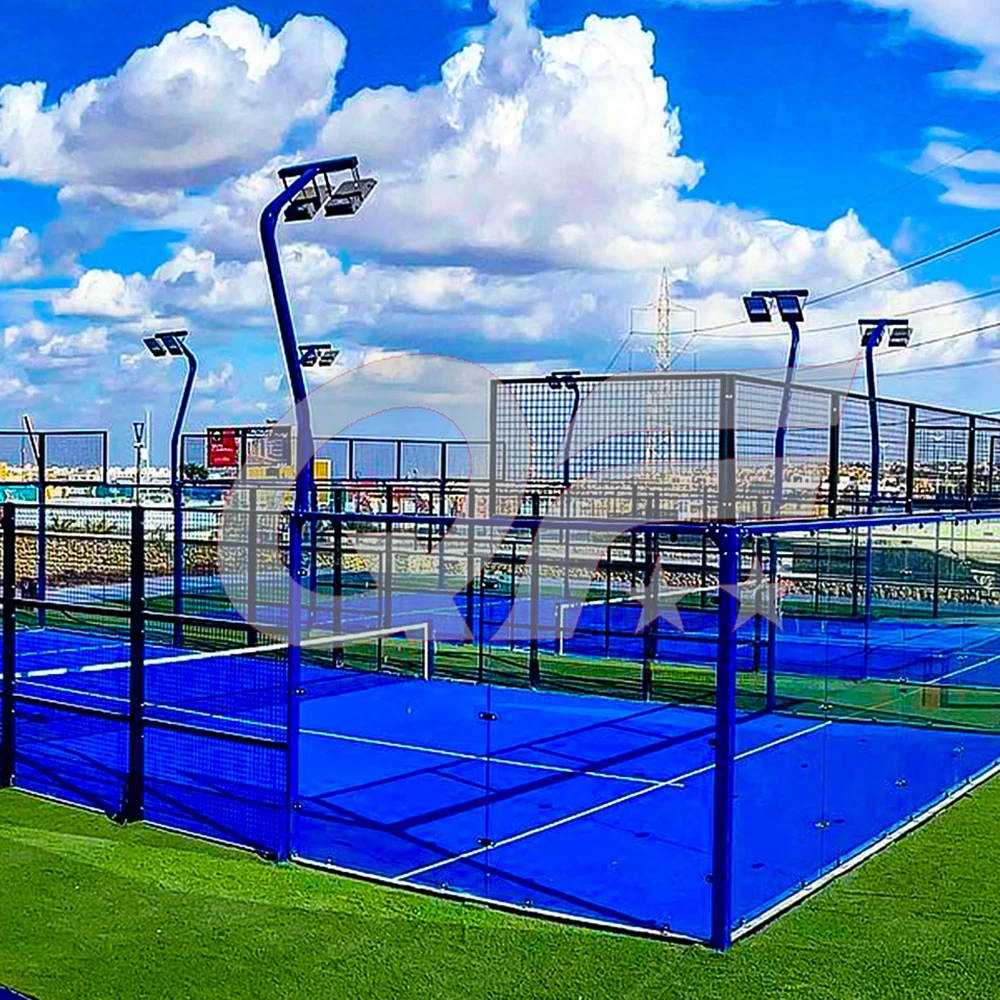
This configuration can be considered by clubs that need a standard-size court for regular operation and prefer to compare suppliers against clearly defined specifications rather than an unspecified package.
What Should Be Included in a Padel Court Quotation?
A useful quotation should make the complete court configuration clear. Instead of comparing only the total price, buyers should check whether the quoted package includes the structure, glass, artificial turf, quartz sand, mesh and lighting.
The quotation should also define the foundation requirements, anchoring method and drainage conditions. For international projects, the installation scope, technical drawings and installation guidance should be stated separately so the buyer knows what is included before construction begins.
Delivery and after-sales terms also need to be clear. Production, packaging, shipping, spare parts, warranty and technical support can all affect the final project cost.
A supplier quotation should therefore allow buyers to compare the same specifications on a like-for-like basis. This is particularly important when several courts are being purchased for one club project.
FAQ
Q1: What is the standard padel court size?
The standard doubles padel court is 20 m × 10 m. Clubs should also allow additional space for circulation, access and safety.
Q2: What thickness of glass is used for a padel court?
The supplied guidelines list 12 mm tempered glass as a standard option. Super or competition-level courts may also use 12 mm tempered or 6+6 mm laminated glass.
Q3: What artificial grass is suitable for a club padel court?
The project guidelines identify curled monofilament turf as a preferred club-level option, with turf height commonly around 10–12 mm.
Q4: How much lighting does a club padel court need?
The supplied guidelines recommend 300–500 Lux for club and recreational use. Professional competition may require 500–750+ Lux.
Q5: What should I ask a padel court manufacturer before ordering?
Ask for the complete court specification, foundation requirements, installation scope, delivery terms, warranty and after-sales support. This makes supplier quotations easier to compare.
Conclusion
Choosing a super padel court for a club requires more than checking the size. Buyers should review the glass, artificial grass, lighting and frame together, then confirm that the foundation, drainage and outdoor protection match the site conditions.
A detailed specification also makes procurement easier. When the court configuration, installation scope and after-sales terms are clearly defined, clubs can compare quotations on the same basis and reduce unexpected requirements during installation.
Planning a padel club project? Contact Qifan for a customized court configuration and quotation based on your site, usage and branding requirements.